Haydn: String Quartet, Op. 51 'Seven Last Words'
Carmina Quartet Schola Romana Lucernensis, Pater Roman Bannwart
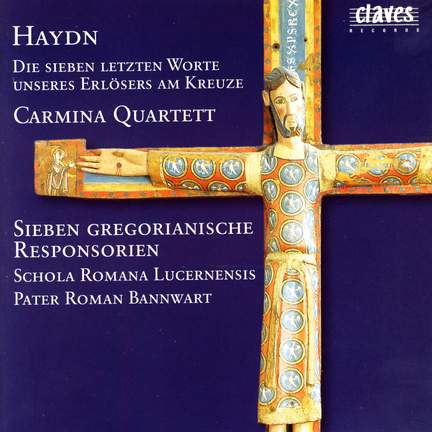
Haydn's Seven Last Words was designed for performance in Holy Week, in the Santa Cueva grotto in Cádiz, with discourses from the bishop on each of the seven utterances followed by Haydn's musical...
Haydn: String Quartet, Op. 51 'Seven Last Words'
Carmina Quartet Schola Romana Lucernensis, Pater Roman Bannwart
Purchase product
Haydn's Seven Last Words was designed for performance in Holy Week, in the Santa Cueva grotto in Cádiz, with discourses from the bishop on each of the seven utterances followed by Haydn's musical...
About
With Seven Gregorian Responsories for Holy Week
Contents and tracklist
- Carmina Quartet, Schola Romana Lucernensis
- Pater Roman Bannwart
Awards and reviews
 2010
2010
Haydn's Seven Last Words was designed for performance in Holy Week, in the Santa Cueva grotto in Cádiz, with discourses from the bishop on each of the seven utterances followed by Haydn's musical meditation. Originally these were orchestral pieces, not the string quartet versions (arranged by Haydn to widen access to the music) which are more often given today.
Haydn was concerned that 'seven Adagios' would be exhausting to the listener, and probably wouldn't have favoured performing them without a break. The idea of interspersing them with Holy Week Gregorian responsories is certainly an appropriate solution.
The group singing them here is a mixed choir, although we hear either the men or the women, never the two together. They sing in a carefully moulded style, cadences softly rounded off; ensemble is precise, from the women especially.
The Carmina Quartet plays with a remarkably wide range of expression. The Introduction is quite fiercely done, and the 'Terremoto' at the end has a violence and is taken at a pace that almost obscures the pulse of the music.
In between, they play the 'seven Adagios' (as Haydn called them – actually three Largos, two Graves, a Lento and an Adagio) as they would any other Haydn slow movement. The first is quite relaxed and lyrical, although its accents are well marked, and it has touches of added ornamentation.
Refinement and delicacy of line characterise the second, and the third, the E major meditation on 'Mother, behold thy son', is done with much tenderness.
In the fourth their realisation of Haydn's notated ornaments – the appoggiaturas in bars 2 and 4, and at several points later – are oddly perverse and disturbing: one played short, the other long, although the second phrase is a clear echo of the first. No 5 ('I thirst') again draws some very telling soft playing from the quartet, but also pained forzato accents, and there's forceful expression of 'Consummatum est', along with moments of tenderness. They play the E flat No 7 with the sense of calm and fulfilment that Haydn surely sought. Their tempos, generally, are well chosen, perhaps faster at times than many quartets take these pieces, but this helps bridge the gulf between Haydn's normal mode of expression and the special significance of this remarkable music.