Special offer. Puccini: Turandot
Birgit Nilsson (Turandot), Peter Klein (Altoum), Giuseppe di Stefano (Calaf), Leontyne Price (Liu), Nicola Zaccaria (Timur), Kostas Paskalis (Ping), Ermanno Lorenzi (Pang), Murray Dickie (Pong) & Alois Pernersdorfer (Mandarin)
Choir & Orchestra of the Vienna State Opera, Francesco Molinari-Pradelli
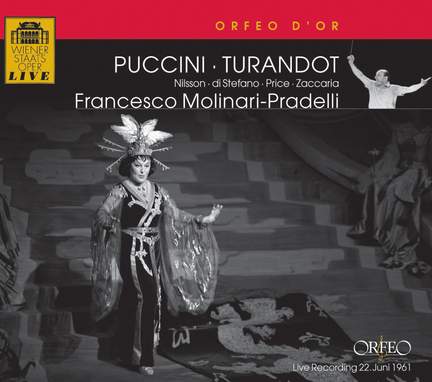
It's not so hard to think oneself present, especially when the recording is as vivid as this and the performance so compelling. It was a special night in Vienna. Karl Löbl wrote it up (and partly...
Special offer. Puccini: Turandot
Birgit Nilsson (Turandot), Peter Klein (Altoum), Giuseppe di Stefano (Calaf), Leontyne Price (Liu), Nicola Zaccaria (Timur), Kostas Paskalis (Ping), Ermanno Lorenzi (Pang), Murray Dickie (Pong) & Alois Pernersdorfer (Mandarin)
Choir & Orchestra of the Vienna State Opera, Francesco Molinari-Pradelli
Purchase product
It's not so hard to think oneself present, especially when the recording is as vivid as this and the performance so compelling. It was a special night in Vienna. Karl Löbl wrote it up (and partly...
About
They made a distinctly odd couple onstage: she was the supreme hochdramatisch soprano of her generation, a singer able to maintain her tremendous vocal powers over a period of several decades, whereas he could captivate his listeners as a poetic and spirited lyric tenor so prodigal with his resources that within little more than a decade he had burned out. It was in 1961 that Birgit Nilsson appeared alongside Giuseppe di Stefano in a performance of Puccini's Turandot which, caught on the wing by by the microphones of Austrian Radio, manages not to be simply a duel between two vocal gymnasts anxious to display their top notes. As Calaf, Giuseppe di Stefano, who died on 3rd March at the age of 86, genuinely gives the impression that he is able to melt the Ice Princess with his mellifluous tenor and ingratiating timbre. Especially towards the end of her killer role, Nilsson shows that she has at her disposal the soft notes and subtle nuances needed to effect this change to a sense of greater humanity. This exceptional cast is completed by Leontyne Price as Liù. Rarely in the history of opera before or since have three such distinguished singers appeared together onstage. This new production of Turandot was conducted by Francesco Molinari-Pradelli, at that time one of the most sought-after conductors of the Italian repertory.
Contents and tracklist
- Alois Pernerstorfer, Giuseppe di Stefano, Nicola Zaccaria, Peter Klein, Birgit Nilsson, Leontyne Price
- Chor der Wiener Staatsoper, Wiener Staatsoper
- Francesco Molinari-Pradelli
- Recorded: 22 June 1961
- Recording Venue: Live recording, Vienna, Austria
Awards and reviews
 2010
2010
It's not so hard to think oneself present, especially when the recording is as vivid as this and the performance so compelling. It was a special night in Vienna. Karl Löbl wrote it up (and partly down) for his paper at the time, and now, contributing the notes for this issue, says of his generation that they didn't know how lucky they were. He is clearly convinced that, whatever the shortcomings then, they were great times compared with the pallid present.
And it's true we have no Birgit Nilsson now.
She is in magnificent form here. Though she is singing much of the time from some way back on stage, the sound is still immensely powerful, and when she does come down front for the final duet we mentally take a step or two back. Much of the special interest, however, lies with the Calaf and the Liù. Di Stefano wins through by the conviction of all he sings: blazing, for instance, in the enigmas. Leontyne Price, too, brings unusual intensity to her role. Vibrant and warm in tone, she shades her phrases sensitively, disappointing only in that she does not resist the temptation to make an effect by investing the B flat of “Signore, ascolta” with a crescendo. The others – the aged Emperor, the deposed King and the three quaint Ministers – are strongly cast, and the chorus make a grand contribution.
Molinari-Pradelli conducts with more character than in the famous studio set, and the recording picks out details of orchestration we may well have missed in other, technically better balanced, versions.
 Awards Issue 2008
Birgit Nilsson… is in magnificent form here. Though she is singing much of the time from some way back on stage, the sound is still immensely powerful, and when she does come down front for the final duet we mentally take a step or two back. Di Stefano wins through by the conviction of all he sings: blazing, for instance, in the enigmas. Leontyne Price, too, brings unusual intensity to her role. Molinari-Pradelli conducts with more character than in the famous studio set...