Verdi: Requiem
Luciano Pavarotti, Samuel Ramey, Cheryl Studer, Dolora Zajick
Orchestra Del Teatro Alla Scala Di Milan, Coro Del Teatro Alla Scala Di Mil, Riccardo Muti
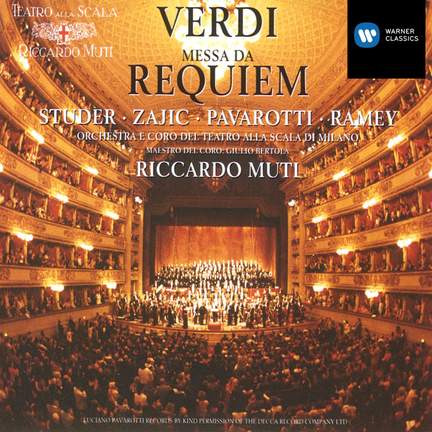
Muti's tempos, both in his 1979 EMI version and here, are substantially faster (Sanctus) or slower (opening Kyrie, 'Rex tremendae', 'Lacrymosa') than Verdi indicates and permits far more rallentandos...
Verdi: Requiem
Luciano Pavarotti, Samuel Ramey, Cheryl Studer, Dolora Zajick
Orchestra Del Teatro Alla Scala Di Milan, Coro Del Teatro Alla Scala Di Mil, Riccardo Muti
Purchase product
Muti's tempos, both in his 1979 EMI version and here, are substantially faster (Sanctus) or slower (opening Kyrie, 'Rex tremendae', 'Lacrymosa') than Verdi indicates and permits far more rallentandos...
About
Contents and tracklist
- Cheryl Studer (soprano), Dolora Zajic (mezzo-soprano), Luciano Pavarotti (tenor), Samuel Ramey (bass)
- Teatro alla Scala
- Riccardo Muti
- Recorded: 1987-06-29
- Recording Venue: 26 & 29 June 1987, live at the Teatro alla Scala, Milan
- Samuel Ramey (bass), Dolora Zajic (mezzo-soprano), Cheryl Studer (soprano), Luciano Pavarotti (tenor)
- Teatro alla Scala
- Riccardo Muti
- Recorded: 1987-06-29
- Recording Venue: 26 & 29 June 1987, live at the Teatro alla Scala, Milan
- Cheryl Studer (soprano), Dolora Zajic (mezzo-soprano), Luciano Pavarotti (tenor), Samuel Ramey (bass)
- Teatro alla Scala
- Riccardo Muti
- Recorded: 1987-06-29
- Recording Venue: 26 & 29 June 1987, live at the Teatro alla Scala, Milan
- Cheryl Studer (soprano), Dolora Zajic (mezzo-soprano), Luciano Pavarotti (tenor), Samuel Ramey (bass)
- Teatro alla Scala
- Riccardo Muti
- Recorded: 1987-06-29
- Recording Venue: 26 & 29 June 1987, live at the Teatro alla Scala, Milan
Awards and reviews
 2010
2010
Muti's tempos, both in his 1979 EMI version and here, are substantially faster (Sanctus) or slower (opening Kyrie, 'Rex tremendae', 'Lacrymosa') than Verdi indicates and permits far more rallentandos than are marked. Nobody wants slavish adherence to what may be accounted only as suggestions on the composer's part, but Muti does sometimes lose the overall view of a movement by overplaying his hand as an interpreter. That's the main criticism of a performance that's certainly positive in terms of its dramatic strength, deriving from Muti's close rapport with his Scala forces.
Here he has a very different chorus from the much smaller professional British group on his earlier set (on EMI Double Forte). That has advantages and disadvantages. The sound here is grander, more specifically operatic in scale as one would expect, with some arrestingly histrionic effects such as the bold, blackbrowed singing at 'Rex tremendae' and the awed senza misura incantation at the start of the 'Libera me'. But there isn't quite the bright, incisive quality found on the former recording.
The performance starts hesitantly, particularly where the soloists are concerned. Cheryl Studer initially seems a shade tentative and over-awed, but as the evening develops she confirms what a fine lirico-spinto soprano she is. The final phrase of the 'Offertorio' is perfectly accomplished and the whole of the 'Libera me' is delivered with strong, firm tone and a deal of passion. Her slightly resinous tone blends very well with Zajick's in the 'Recordare' and the Agnus Dei, one of the set's most successful movements. On her own Zajick also improves from an anonymous start to reach heights of eloquence at the start of the 'Lux aeterna'. The dark grain of her chest register contrasts with a degree of brilliance at the top.
Many will probably buy the recording for Pavarotti. He's in his best, most persuasive form, more individual and subtle in utterance than for Solti (Decca), even if the voice has lost a little of its old opulence. He's also more considerate of his colleagues in the unaccompanied passages, which here are as carefully blended as on any recording, much helped by Ramey's solid bottom line. Ramey trumps even Pavarotti at 'Hostias' in the 'Domine Jesu', his dolcissimo singing here full of inward feeling. 'Oro supplex', taken up to Verdi's tempo rather than being dragged as it can be by heavier basses, is firmly and securely phrased. Others have sung the bass part with more character, few – except Pinza – with such security and musicality.
The recording is rather recessed with the character of the soloists' voices hard to discern.
However, where the chorus and orchestra are concerned, the newer Muti certainly achieves a theatrical perspective, catching the atmosphere of La Scala, and the choral recording obviously has a bigger range than on his old set.