Handel: Rodrigo
Gloria Banditelli, Sandrine Piau, Roberta Invernizzi, Elena Cecchi Fedi, Rufus Müller, Caterina Calvi
Il Complesso Barocco, Alan Curtis
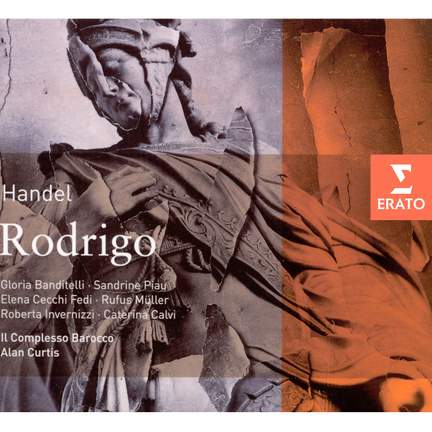
Under Curtis's lively direction, the dramatic tension builds up splendidly.
Handel: Rodrigo
Gloria Banditelli, Sandrine Piau, Roberta Invernizzi, Elena Cecchi Fedi, Rufus Müller, Caterina Calvi
Il Complesso Barocco, Alan Curtis
Purchase product
Under Curtis's lively direction, the dramatic tension builds up splendidly.
About
Contents and tracklist
- Caterina Calvi (vocals), Rufus Müller (vocals), Gloria Banditelli (soprano), Sandrine Piau (soprano), Roberta Invernizzi (soprano), Elena Cecchi Fedi (soprano)
- Il Complesso Barocco
- Alan Curtis
- Recorded: 1997-07-31
- Recording Venue: July 1997 / Basilica dell'Osservanza, Siena
Rodrigo HWV5 (1999 Digital Remaster), Act 1, Scena 4: Recitativo: ' Esilena? mio re' (Rodrigo, Esilena)
Track length0:16
Rodrigo HWV5 (1999 Digital Remaster), Act 2, Scena 5: Aria: 'Siete assai superbe, o stelle' (Rodrigo)
Track length2:54
Recitativo e recitativo accompagnato: 'Non cedrò (Rodrigo, Evanco, Giuliano, Florinda)
Track length5:02
Awards and reviews
 August 2007
Under Curtis's lively direction, the dramatic tension builds up splendidly.
 2010
2010
The music of Handel's Italian years has a unique freshness, a boldness of invention, a novelty in textures and lines – characteristics which distinguish his first Italian opera, Rodrigo, written in 1707 for the Medici court at Florence. This recording restores all that survives of the lyrical music, with one item composed in a more-or-less Handelian manner by Curtis and other Handel music imported to fit the original text. Curiously, the dances aren't included here, and – presumably in the interest of keeping the set to two CDs – there are many large cuts in the recitative. As a result some quite important sections are omitted and the often very close succession of lyrical numbers gives a slightly misleading impression of the opera. Even so the recording of this fine, often very moving and mostly inspiriting piece is warmly welcome.
Like most Italian operas of its time, it's essentially a succession of arias, mostly shorter ones than those of Handel's mature operas. As so often with Handel, much of the finest music comes in Act 2, with a pair of arias for Esilena (the second a furious outburst), and at the beginning of the next act, with Rodrigo and Esilena apparently facing death, Handel finds that marvellous vein of pathos familiar in his later operas. Alan Curtis, a man of the theatre, keeps the score moving along at a good pace.
He conducts, as it were, from a 17th- century standpoint, with a flexibility over accent and metre that allows the music to move unusually freely. Yet he's rather predictable in his use of cadential rallentandos, and there are points where the orchestral discipline is a shade loose.
Sandrine Piau sings Esilena's part beautifully, with much attention to detail, to timing and to phrasing, as well as with fluency and with a richness of tone unusual for her. Gloria Banditelli makes a sturdy Rodrigo, direct and accurate, and very controlled in the fast semiquaver passages. Elena Cecchi Fedi perhaps overdoes the characterisation of Florinda as a shrew, singing shrilly at times and with rather more shouting and pouting than is consistent with musical enjoyment. But the singing is powerful and brilliant in its way. There's competent and spirited playing from Il Complesso Barocco, and excellent notes from Anthony Hicks and Curtis.