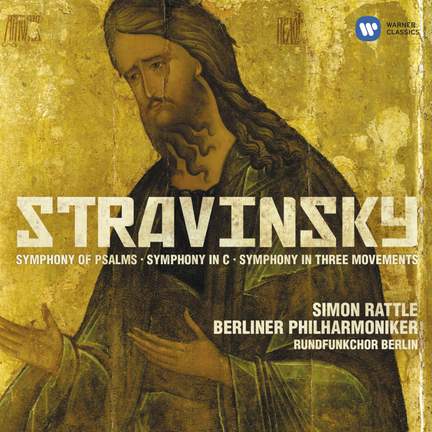
Simon Rattle conducts Stravinsky
Recorded Live in September 2007
Berliner Philharmoniker & Rundfunkchor Berlin, Sir Simon Rattle
Awards:
-
Building a Library, October 2009, First Choice

-
Grammy Awards, 51st Awards (2008), Best Choral Performance

The slow movements of both the Symphony in Three Movements and the Symphony in C are beautifully done.
Simon Rattle conducts Stravinsky
Recorded Live in September 2007
Berliner Philharmoniker & Rundfunkchor Berlin, Sir Simon Rattle
Purchase product
Awards:
-
Building a Library, October 2009, First Choice
-
Grammy Awards, 51st Awards (2008), Best Choral Performance
The slow movements of both the Symphony in Three Movements and the Symphony in C are beautifully done.
About
Contents and tracklist
III. Alleluja. Laudate Dominum
Track length12:43
This track is only available as an album download.
Moderato alla breve
Track length10:16
This track is only available as an album download.
Awards and reviews
 Proms 2008
The slow movements of both the Symphony in Three Movements and the Symphony in C are beautifully done.
 2010
2010
The Symphony in Three Movements doesn't so much start as erupt and Sir Simon Rattle's second recording of it has impressive immediacy, richer tonally than his rougher-edged 1980s recording with the CBSO, but textually warmer and with more refined solos. Interesting points of comparison arise at around 4'00” into the first movement (chamber-like textures involving strings and winds) and the serene passage for strings and harp at 2'08” into the second movement, the relative earnestness of the earlier version replaced here by a true but 'terrible beauty'.
In comparison with conductors like Boulez and Gielen, Rattle offers the most polished option, mindful of both mood and structure and beautifully engineered, but don't forget Stravinsky's own 1946 (New York Philharmonic) version, which reflects a new-born masterpiece in the heat of its creation.
Rattle's Symphony of Psalms is very sensitively traced, with a rowdy account of the reveille-style 'Laudate Dominum' passage in the last movement.
However, the real highlight of this CD is Rattle's pressing but never impatient account of what in my view is Stravinsky's greatest symphony, the terse and poignant Symphony in C, music forged in the wake of illness and death but that only ever suggests anguish, never confesses it. Tchaikovsky's spirit looms large, especially in the first movement, at the onset of the angry central climax where Rattle and his Berliners achieve considerable intensity. Rattle focuses each episode without sounding episodic and shapes the Larghetto's opening most poetically.
Stravinsky himself is faster and lighter (especially on his second, stereo, recording) but Rattle gives us both urgency and tonal body. Henceforth, his is a digital front-runner. (And if purchased as a download, a finely observed account of the Symphonies of Wind Instruments is thrown in as a generous bonus.)
 August 2008
The real highlight of this CD is Rattle's pressing but never impatient account of what in my view is Stravinsky's greatest symphony, the terse and poignant Symphony in C… Stravinsky himself is faster and lighter… but Rattle gives us both urgency and tonal body. Henceforth, his is a digital front-runner.
 15th June 2008
Rattle gives [the woodwind] Mozartian prominence above the transparent strings, and this is music to which the British conductor brings a special empathy. In the Psalm settings, the Rundfunkchor Berlin, now under Simon Halsey, give exemplary accounts of their music. These are luxury interpretations in every sense, sumptuously recorded.
 20th June 2008
Rattle's performances, all taken from concerts in Berlin's Philharmonie, are as energised and impeccably played as one would expect, with the woodwind contributions a particular delight. Predictably, it's the last of the trilogy, the stark Symphony in Three Movements from 1946, that makes the biggest impression, with Rattle channelling its energy and athleticism uncompromisingly. Yet all three works have a litheness and confidence, a perfect balance between the sections, and, in the Symphony of Psalms, between the orchestra and the superbly groomed choir, that give the music a transparent, "classical" feel. Rattle's performance of the Symphony of Psalms gets the balance between celebratory exuberance and liturgical grandeur exactly right, releasing the energy of the finale in a controlled display of orchestral virtuosity.
 14th July 2009
The Berliners are adept at finding exactly the right mode for each work –perkily antiquated for the Symphony in C, muscular and athletic for the Symphony in Three Movements and intense for the Symphony of Psalms. I wasn’t sure Simon Rattle could do spiritual, but here he proves he can.
28th June 2008
As one might expect from these forces, the asceticism of neo-Classical Stravinsky plays second fiddle to the orchestra's natural plushness. But while the textures sound a little weightier than we are used to, Simon Rattle's mastery in orchestral balancing ensures that nothing is compromised.
There is some delectable playing here, especially from the woodwind in the Bachian counterpoint at the heart of the Symphony of Psalms, where the Berlin Radio Chorus also excels. And the richness of sound does nothing to dampen the rhythmic vitality that is at the heart of the two purely instrumental works