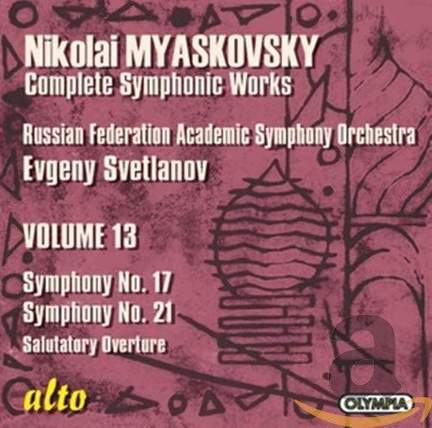
Myaskovsky - Complete Symphonic Works Vol. 13
Russian Federation Academic Symphony Orchestra, Evgeny Svetlanov
Though presumably similarly sourced, the transfers on these two issues are not always identical in matters of balance and equalisation. The main drawback of the Warner set is the skimpiness...
Myaskovsky - Complete Symphonic Works Vol. 13
Russian Federation Academic Symphony Orchestra, Evgeny Svetlanov
Purchase product
Though presumably similarly sourced, the transfers on these two issues are not always identical in matters of balance and equalisation. The main drawback of the Warner set is the skimpiness...
About
Contents and tracklist
Work length10:02
- State Academic Symphony Orchestra "Evgeny Svetlanov"
- Evgeny Svetlanov
Miaskovsky:
Symphony No. 17 in G-Sharp Minor, Op. 41
Work length48:27
- State Academic Symphony Orchestra "Evgeny Svetlanov"
- Evgeny Svetlanov
I. Lento - Allegro molto agitato
Track length15:51
II. Lento assai - Andantino (ma non troppo)
Track length16:52
III. Allegro poco vivace
Track length5:15
IV. Andante - Allegro molto animato
Track length10:29
Work length18:40
- State Academic Symphony Orchestra "Evgeny Svetlanov"
- Evgeny Svetlanov
Awards and reviews
 2010
2010
Though presumably similarly sourced, the transfers on these two issues are not always identical in matters of balance and equalisation. The main drawback of the Warner set is the skimpiness of its annotations.
Mussorgsky Opera Alto remains committed to giving us the contextual material such unfamiliar scores can scarcely do without. Its makeweight here is a case in point. A seemingly innocuous overture, it turns out to have been the composer's contribution to Stalin's 60th birthday celebrations in 1939. In which case its avoidance of vulgarity may even be considered quietly heroic.
Of the two symphonies in the Alto instalment, the 17th (1936-37) is indubitably a large statement.
Composed at the height of the Great Terror, its idiom seems a little more extroverted than usual, Rachmaninov crossed with Khachaturian perhaps. The epic slow movement will be a must for listeners with a sweet tooth even if things could, with advantage, move on a little faster! Liadov meets Korngold in the Trio of the third. You may well have come across this performance in an earlier Melodiya incarnation.
The 21st (1940) was long Myaskovsky's calling- card. It was commissioned by the Chicago SO and there are vintage recordings originating from both sides of the Iron Curtain.
None is as long-breathed as this one. Perhaps one can forgive the blaring confusion of Svetlanov's climaxes for the nobility of his take on the elevated, Roy Harris-style opening section. The score's most memorable idea, referencing Rimsky's Antar Symphony, has that authentic Myaskovsky lyricism in spades and of course Svetlanov milks it for all it's worth. Glorious heartfelt stuff although those brought up on more tautly controlled readings may cry self-indulgence. As usual the playing ranges from the inspired to the sketchy, the results compellingly 'noble' even where manifestly flawed.
For anyone coming fresh to the composer and his world, the Warner set provides an extraordinarily economical, if potentially mystifying, entrée.
 October 2008
The 21st (1940) was long Myaskovsky's calling-card. The score's most memorable idea, referencing Rimsky's Antar Symphony, has that authentic Myaskovsky lyricism in spades and of course Svetlanov milks it for all it's worth. Glorious heartfelt stuff although those brought up on more tautly controlled readings may cry self-indulgence.