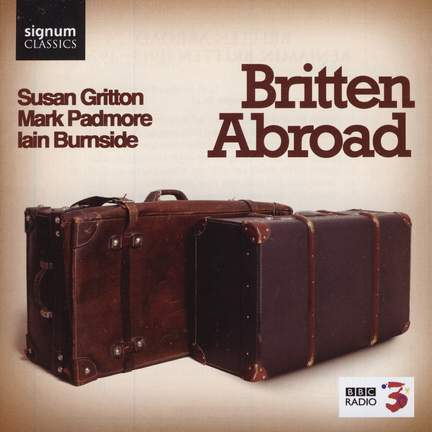
Britten Abroad
Susan Gritton (soprano), Mark Padmore (tenor) & Iain Burnside (piano)
What an inspired idea not only to bring together Britten's mature foreign-language songs, but also to have the programme shared by two of Britain's keenest and brightest singers. …delight and...
Britten Abroad
Susan Gritton (soprano), Mark Padmore (tenor) & Iain Burnside (piano)
Purchase product
What an inspired idea not only to bring together Britten's mature foreign-language songs, but also to have the programme shared by two of Britain's keenest and brightest singers. …delight and...
About
Britten's settings of Italian, Russian, French and German, performed here by Susan Gritton, Mark Padmore and Iain Burnside are certainly amongst the most distinctive and very finest examples of his art, each fashioned specifically for a much-loved and favoured artist.
The Seven Sonnets of Michelangelo were completed in America in October 1940 and were the first songs written specifically for Britten's life-long partner and principal interpreter, the tenor Peter Pears, to whom they are dedicated and unquestionably addressed. Britten and Pears premiered the Michelangelo Sonnets at the Wigmore Hall on 23 September 1942, the first of many memorable appearances they were to make in London's premiere recital hall over the next three decades.
The Poet's Echo was written during a holiday that Britten and Pears spent in the Soviet Union with Galina Vishnevskaya and Mstislav Rostropovich in August 1965.The cycle is dedicated to 'Galya and Slava' and was first performed by the dedicatees in the Small Hall of the Moscow Conservatoire, on 2 December 1965; they gave the UK premiere on 2 July the following year, in London's Royal Festival Hall.
Um Mitternacht was written around 1960. It was first performed by the soprano Lucy Shelton and pianist Ian Brown at the 1992 Aldeburgh Festival and only entered the repertory with the publication of The Red Cockatoo & Other Songs by Faber Music in 1994. It is unique in that it's Britten's only setting of Goethe, an anthology of whose verse he received around this time from his friend Prince Ludwig of Hesse and the Rhine, the dedicatee of the final song-cycle on the present disc, the Sechs Hölderlin-Fragmente. Britten and Pears recorded them for the BBC Third programme on 20 October 1958.
Contents and tracklist
Awards and reviews
 Proms 2008
What an inspired idea not only to bring together Britten's mature foreign-language songs, but also to have the programme shared by two of Britain's keenest and brightest singers. …delight and spiritual depths go hand in hand.
 2010
2010
Britten is 'abroad' here in the sense that he is occupied with foreign texts. He is also away in time. The breadth of cultural reference is large, involving four languages, none of them his own.
The recital, then, challenges its listeners as well as its performers.
And how these two singers have grown, both in voice and artistry. The languages assist in the sense we have of them as being transformed.
Mark Padmore in Italian, Susan Gritton in Russian show themselves in new guises. Each is ines- capably performing in the shadow of a great original; but even as (in our minds) we hear Pears and Vishnevskaya, recognising that their voices are written into these songs, we can acknowledge these younger artists as worthy successors, and (to be honest) part of us is glad to be hearing them instead. Padmore has now quite a full-bodied ring to his voice at a forte (hear him in the strong affirmations of the last sonnet), and Gritton commands an aristocratic concentration of tone, unshakeably firm and precise in its placing.
Iain Burnside more than copes with the formidable technical difficulties, and in many songs (for instance, the last of the Pushkin poems with its ticking clock, or the spinning-wheel in 'Fileuse' mingling past and present in the old woman's thoughts) we bless the imaginative touch.
Recorded sound is fine, as are John Evans's introductory notes.
 Awards Issue 2008
…how these two singers have grown, both in voice and artistry. Padmore has now quite a full-bodied ring to his voice at a forte (hear him in the strong affirmations of the last sonnet), and Gritton commands an aristocratic concentration of tone, unshakeably firm and precise in its placing. Iain Burnside more than copes with the formidable technical difficulties, and in many songs... we bless the imaginative touch.

Mark Padmore's singing of the Michaelangelo Sonnets has all the grace of the young Pears without his mannerisms … Iain Burnside is a tower of strength throughout
 30th May 2008
Tenor Mark Padmore takes the Michelangelo cycle by the throat, and wrings out of it a powerfully eloquent performance, and he's equally persuasive in the Hölderlin settings, while soprano Susan Gritton does not attempt the histrionics that Vishnevskaya brought to the Pushkin songs, but invests them instead with genuinely credible dramatic intensity. Iain Burnside is a model accompanist. An outstanding disc.
 17th May 2008
With the ever-inventive Iain Burnside at the piano, revelling in Britten's keyboard felicities, the vocal honours are shared evenly by soprano and tenor. Mark Padmore is commanding in the Italianate, almost bel canto style of the Michelangelo sonnets, and Susan Gritton's rich-hued timbre and linguistic mastery reap rewards in the Russian and German cycles.
 24th May 2008
The tenor Padmore is easy over the horn-blown heights in Veggio co'bei. Gritton is more shrill and rather overdoes the Pushkin poems The Poet's Echo, although she shows agonised restraint in the paranoid last...Gritton all but steals the album with the haunting Il est Quelqu'un. Burnside gives witty impressions of a spinning wheel, insomniac's clock and Messiaen-like nightingale at the keys.