James Dillon - The Soadie Waste
Irvine Arditti (violin), Noriko Kawai (piano) & Hiroaki Takenouchi (piano)
Arditti Quartet
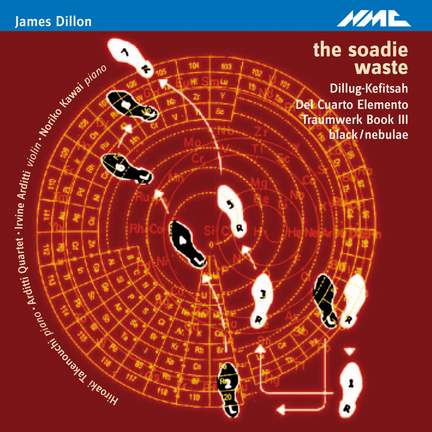
The 27-year period covered by this group of compositions, taking James Dillon from his mid-twenties to his early fifties, could hardly fail to outline substantial changes. Dillug-Kefitsah (1976)...
James Dillon - The Soadie Waste
Irvine Arditti (violin), Noriko Kawai (piano) & Hiroaki Takenouchi (piano)
Arditti Quartet
Purchase product
The 27-year period covered by this group of compositions, taking James Dillon from his mid-twenties to his early fifties, could hardly fail to outline substantial changes. Dillug-Kefitsah (1976)...
About
Following her acclaimed recording of Dillon's Book of Elements, Noriko Kawai returns to NMC - joined by Irvine Arditti and the Arditti Quartet, in their first recording for NMC. This disc spans Dillon's career - from early piano caprice Dillug-Kefitsah, and the phantasmagorical sequence Traumwerk, for violin and piano, to brooding piano duo black/ nebulae - with pianist Hiroaki Takenouchi - and piano quintet the soadie waste, which takes its name from a dilapidated Glaswegian dance hall on the site of a former chemical-works; it was said that during 'hot' dance sessions the locals could detect chemical seepage.
Contents and tracklist
Awards and reviews
 2010
2010
The 27-year period covered by this group of compositions, taking James Dillon from his mid-twenties to his early fifties, could hardly fail to outline substantial changes. Dillug-Kefitsah (1976) might well be fully representative in its relish for weird titles and joyful technical radicalism, shifting between gentleness and turbulence in thoroughly disconcerting ways.
But it gives little sign of the delight in forceful pattern-making and affectionate allusion to a Glaswegian location that makes the soadie waste (2003) such a bracing and engaging experience.
The more confidently international Dillon's range of reference, the more resourceful his acknowledgement of his native Scots roots becomes.
The two big works here, black/nebulae (1994) and Traumwerk Book III (completed 2002) belong to a time when Dillon was deep in largerscale projects. Yet neither sounds remotely like music of reduced ambition or limited scope.
The space/time drama underpinning black/nebulae promotes a surface that seethes and erupts in 20 effortlessly sustained minutes of duo-pianistic bravura, in which meticulous coordination is as crucial as assertive independence. The 12 miniatures of the Traumwerk collection are even more fastidious in their intricacy, yet the result is often playful, even nonchalant, as Irvine Arditti and Noriko Kawai make light (apparently) of the formidable challenges presented.
Arditti is also characteristically arresting in the 10-minute solo piece Dillon wrote for him in 1988 and named after the fourth element, water.
The music, a miniature drama, is not merely liquid-like in its fluidity but is constantly reaching and retreating from boiling-point.
These performances benefit greatly from the crystal-clear Potton Hall acoustics. With luck, some of Dillon's more substantial works from recent years – even, perhaps, the opera Philomela – will turn up on disc before too long.
 Awards Issue 2008
An arresting survey of a composer noted for the cerebral and the visceral