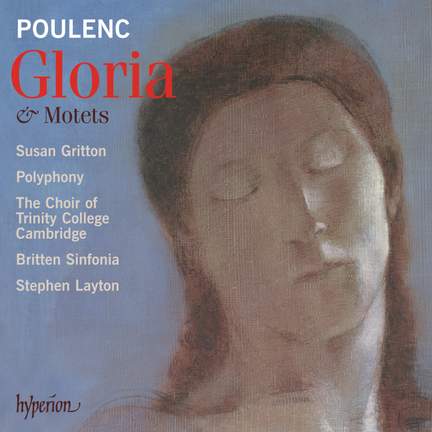
Poulenc - Gloria and Motets
Susan Gritton
Polyphony, Britten Sinfonia, The Choir of Trinity College, Cambridge, Stephen Layton
Awards:
-
Gramophone Awards, 2008, Finalist - Choral

-
Gramophone Magazine, April 2008, Editor's Choice

-
Building a Library, February 2020, Also Recommended

Stephen Layton's tight control of his forces, both choral and orchestral, lends impeccable ensemble and heart-thumping excitement - has the opening tutti ever had such punch? Soprano Susan...
Poulenc - Gloria and Motets
Susan Gritton
Polyphony, Britten Sinfonia, The Choir of Trinity College, Cambridge, Stephen Layton
Purchase product
Awards:
-
Gramophone Awards, 2008, Finalist - Choral
-
Gramophone Magazine, April 2008, Editor's Choice
-
Building a Library, February 2020, Also Recommended
Stephen Layton's tight control of his forces, both choral and orchestral, lends impeccable ensemble and heart-thumping excitement - has the opening tutti ever had such punch? Soprano Susan...
About
Stephen Layton and Polyphony continue to blaze a trail as great interpreters and dazzling performers of a wide range of choral music. Their recent disc of Bruckner’s Mass in E minor and motets was acclaimed as a benchmark recording. For their latest Hyperion disc they turn to some of the most bewitching and unusual, yet well-loved, choral works of the twentieth century.
Poulenc’s choral music is a deep expression both of his faith and of his unique musical language. In the various motets, the music responds to the composer’s studies of Bach, Monteverdi, Palestrina and Gabrieli, but is always stylistically progressive. Prominently featured are Poulenc’s distinctive and often ingenious chord progressions. Each motet has its own delightfully etched personality.
Poulenc’s Gloria is one of his most enduringly appealing works. In some ways straightforwardly pious, it is also tinged with mischievous irreverence and a sense of rollocking enjoyment. ‘When I wrote this piece’, Poulenc famously recalled, ‘I had in mind those frescoes by Gozzoli where the angels stick out their tongues; and also some serious Benedictine monks I had once seen revelling in a game of football.’ This recording by the Britten Sinfonia, The Choir of Trinity College, Cambridge, Polyphony and the soprano soloist Susan Gritton under Stephen Layton brings out all these aspects in a classic performance.
Contents and tracklist
Spotlight on this release
-
An error occurred.
Try watching this video on www.youtube.com, or enable JavaScript if it is disabled in your browser.
Awards and reviews
-
Gramophone MagazineApril 2008Editor's Choice
 April 2008
Stephen Layton's tight control of his forces, both choral and orchestral, lends impeccable ensemble and heart-thumping excitement - has the opening tutti ever had such punch? Soprano Susan Gritton is superb, too, in her committed, soaring performances. The combined choirs of Trinity College, Cambridge and pro group Polyphony are astounding as a virtuoso choral unit...
 2010
2010
From the very outset of the Gloria it's clear that this is a performance of real distinction. The gloriously pompous opening orchestral fanfare has a swagger and a self-satisfied strut which is one of those rare moments on disc where you would wish it were tracked separately so that you could just play it over and over again. But to do that would miss the scintillating choral entry, the basses starting the ball rolling with the kind of pent-up energy which you just know is going to explode in the most spectacular way. Other recordings have a pleasant, smiley quality here; Stephen Layton's crew has an almost piratical swagger, buoyantly breasting Poulenc's turbulent waves of barely restrained exuberance.
The 38 voices of Polyphony are augmented by 31 from Trinity College, Cambridge, while an unusually hefty contingent of orchestral players makes up the Britten Sinfonia on the disc. What results is not only music-making of immense power and vibrancy – take the riveting declamation 'Qui sedes ad dexteram Patris', hardly subtle or even particularly refined (the men shout and the brass blares) but unbelievably spine-tingling – but also an ability, brilliantly directed by Layton, to capture Poulenc's 'half hooligan, half monk' musical persona (in Claude Rostand's oft-quoted aphorism). Thus, in the final chorus of the Gloria, after the boisterous start, we have a moment of profound sanctity and another, crowned with incredible delicacy by Susan Gritton, of mouth-watering enchantment.
Not everything is quite so enticing: Gritton wallows a little too much perhaps in the 'Domine Deus', mischievously abetted by Layton's almost kitsch romanticism. But it is the vivid sense of unfettered joy in the Gloria and the matchless intensity of feeling revealed in the motets that make this such a gloriously distinguished disc.
 April 2008
From the very outset of the Gloria its clear that this is a performance of real distinction. …the scintillating choral entry, the basses starting the ball rolling with the kind of pent-up energy which you just know is going to explode in the most spectacular way. In the final chorus of the Gloria, after the boisterous start, we have a moment of profound sanctity and another, crowned with incredible delicacy by Susan Gritton, of mouth-watering enchantment.

Poulenc’s riotously wild, spiky and humorous Gloria is given a marvellously fresh interpretation here by Polyphony … but perhaps the real interest in this disc lies in the more unfamiliar motets. Each is an exquisite example of Poulenc’s daring choral writing, handled here by Polyphony with the
same subtlety and skill they brought to their Bruckner Hyperion disc last year