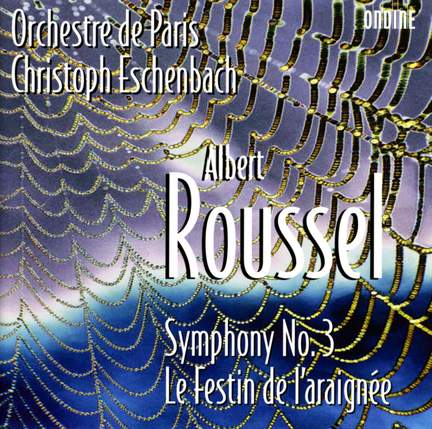
Special offer. Roussel - Symphony No. 3
Orchestre de Paris, Christoph Eschenbach
Eschenbach's understanding of Roussell is manifestly profound and his way with the music quietly compelling and persuasive. Very highly recommended.
Special offer. Roussel - Symphony No. 3
Orchestre de Paris, Christoph Eschenbach
Purchase product
Eschenbach's understanding of Roussell is manifestly profound and his way with the music quietly compelling and persuasive. Very highly recommended.
About
This Albert Roussel disc is the final in a successful cycle of three Ondine releases featuring the four symphonies and two ballets by the French composer.
The Third Symphony, which was given its world première in Boston in 1930, is a true masterpiece and remains the most popular of Roussel's symphonic works. Le Festin de l'araignée (The Spider's Feast) was completed in 1913 and is the second of Roussel's celebrated ballets, the other being Bacchus et Ariane, which was featured on a previous release.While there are many accounts of the symphonic fragments, this disc contains the complete ballet music.The music is energetic, melodic, original, and programmatic, helped by the choreographical annotations from the original score which are contained in the track listing of this CD.The booklet contains expert liner notes from the Centre International Albert-Roussel in France, as well as rare photographs.
Both previous Roussel releases have contributed to a revival of the French composer's music and have earned high praise in the international press.
Contents and tracklist
Awards and reviews
 April 2008
Eschenbach's understanding of Roussell is manifestly profound and his way with the music quietly compelling and persuasive. Very highly recommended.
 18th April 2008
[Eschenbach] subjects [the Third Symphony] to radical scrutiny, though his take on the piece won't be to all tastes. This is a dark interpretation of a work usually considered optimistic and urbane. What we think of as a joyous explosion of rhythm often sounds savage and perplexing. There's turmoil beneath the elegant veneer of the melodic lines. He's right, of course, to argue that we shouldn't dismiss the Third as lightweight. At the same time, it's all a bit too self-consciously done, and Eschenbach seems altogether happier with the ambiguities of Le Festin de l'Araignée...Eschenbach's understanding of the mixture of surface charm and underlying malaise is marvellously acute, and the playing is often devastating in its brilliance.