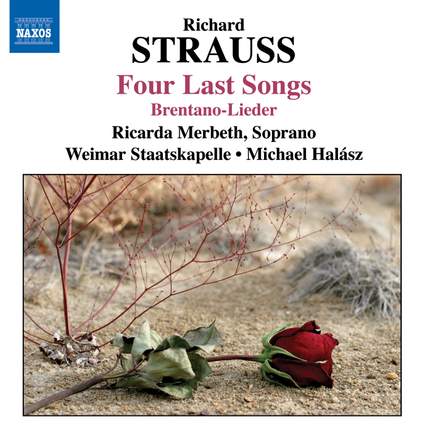
Strauss - Four Last Songs
Ricarda Merbeth (soprano)
Weimar Staatskapelle, Michael Halász
Awards:
-
Gramophone Magazine, May 2008, Editor's Choice

Ricarda Merbeth, a regular Marschallin in Vienna and exponent of other big Strauss roles in Europe, has also been Bayreuth's Elisabeth for the past six years – just as Pauline de Ahna, Strauss's...
Strauss - Four Last Songs
Ricarda Merbeth (soprano)
Weimar Staatskapelle, Michael Halász
Purchase product
Awards:
-
Gramophone Magazine, May 2008, Editor's Choice
Ricarda Merbeth, a regular Marschallin in Vienna and exponent of other big Strauss roles in Europe, has also been Bayreuth's Elisabeth for the past six years – just as Pauline de Ahna, Strauss's...
About
Contents and tracklist
- Ricarda Merbeth (soprano)
- Staatskapelle Weimar
- Michael Halász
- Recorded: 28-30 August 2006
- Recording Venue: Weimarhalle, Weimar, Germany
- Ricarda Merbeth (soprano)
- Staatskapelle Weimar
- Michael Halász
- Recorded: 28-30 August 2006
- Recording Venue: Weimarhalle, Weimar, Germany
- Staatskapelle Weimar
- Michael Halász
- Recorded: 28-30 August 2006
- Recording Venue: Weimarhalle, Weimar, Germany
Awards and reviews
-
Gramophone MagazineMay 2008Editor's Choice
 2010
2010
Ricarda Merbeth, a regular Marschallin in Vienna and exponent of other big Strauss roles in Europe, has also been Bayreuth's Elisabeth for the past six years – just as Pauline de Ahna, Strauss's wife and first muse of song, once was.
There's something both idiomatic and old-fashioned about these performances. Here is neither the ample, creamy sound of a Jessye Norman nor the studied, polished art of the Schwarzkopf/ Legge camp nor the quasi-vocalise of a Janowitz, but rather a welcome, word-conscious directness and emotive agility that is natural and refreshing, and reminiscent of an earlier school of Strausssinging – Lotte Lehmann, Viorica Ursuleac.
The Op 68 Brentano Lieder of 1918 – never programmed enough – are hair-raisingly difficult for the singer in terms of both tessitura and line in their original piano versions. Given in the complex (and quite weighty) orchestrations to which Strauss devoted much energy in later life, they become even more demanding. 'Lied der Frauen wenn die Männer im Kriege sind' ('Women's Song when the Men are away at War') is eight minutes-plus of high drama in instrumental clothing that deliberately harks back to Salome, Elektra and Die Frau ohne Schatten (it's also highly possible that the events of 1933, the year of this version, impinged on the emotional temperature).
The five other songs in the group become enticing orchestral children of their contempo- rary operas Daphne and Capriccio. Merbeth is supremely well prepared and on top of this repertoire, and the Weimar orchestra, cliché to say but true, have the sound of Strauss's music still in their blood. Halász, a regular collaborator of the soprano's, beds down in the tempi of 'Im Abendrot' a little too much but his singer can more than handle that. Natural, unplush sound, aptly matching the music-making.
 May 2008
Merbeth is supremely well prepared and on top of this repertoire, and the Weimar orchestra, cliché to say but true, have the sound of Strauss's music still in their blood.