Special offer. Lennox Berkeley - String Quartets Nos. 1-3
Maggini Quartet
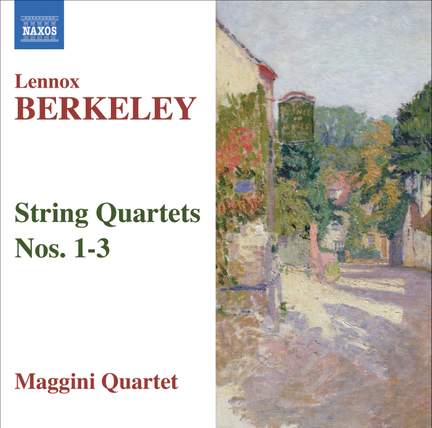
The partnership between Naxos and the Magginis has opened up the British quartet reportoire, and also seen the Quartet itself growing in confidence and maturity. This CD is one of their first...
Special offer. Lennox Berkeley - String Quartets Nos. 1-3
Maggini Quartet
Purchase product
The partnership between Naxos and the Magginis has opened up the British quartet reportoire, and also seen the Quartet itself growing in confidence and maturity. This CD is one of their first...
About
Contents and tracklist
- Maggini Quartet
- Recorded: 7-9 December 2006
- Recording Venue: Potton Hall, Westleton, Suffolk, England
- Maggini Quartet
- Recorded: 7-9 December 2006
- Recording Venue: Potton Hall, Westleton, Suffolk, England
- Maggini Quartet
- Recorded: 7-9 December 2006
- Recording Venue: Potton Hall, Westleton, Suffolk, England
Awards and reviews
 February 2008
The partnership between Naxos and the Magginis has opened up the British quartet reportoire, and also seen the Quartet itself growing in confidence and maturity. This CD is one of their first with Lorraine McAslan as leader, and, remembering her fine Bridge and Britten recordings, I had high hopes: I haven't been disappointed.
 2010
2010
The Maggini turn their attention to Sir Lennox Berkeley, giving us all three of these landmarks in 20th-century British chamber music with the first recordings of Nos 1 and 3.
The First, the longest of the three, is a revelation.
Virtually unknown, it has usually been regarded as just an early work from 1935. Nothing could be more wrong since it's teeming with ideas and ingenious string quartet textures.
There are plenty of Berkeley fingerprints, such as the regular pulse of the second movement supporting diatonic melodies in counterpoint; the high spirits of the Scherzo; and the final theme and variations, which anticipates examples later in the Two-Piano Concerto and the Violin and Piano Sonatina.
The Second (1942) has an eloquent slow movement in what the composer called free form is a fine example of Berkeley's completely individual melodic and harmonic style. By the time of No 3 (1970) Berkeley was in his slightly tougher, final phase. But it is recognisably the same composer and his spiritual roots emerge in the connections between a simple setting of Hail, Holy Queen and the slow movement.
These performances are simply magnificent.
Clean and immediate sound, perhaps slightly shrill. But the main thing is that at last these outstanding chamber works are available. A legacy comparable to Britten's? See what you think – at a bargain price.
 February 2008
These performances are simply magnificent. Clean and immediate sound, perhaps slightly shrill. But the main thing is that at last these outstanding chamber works are available.