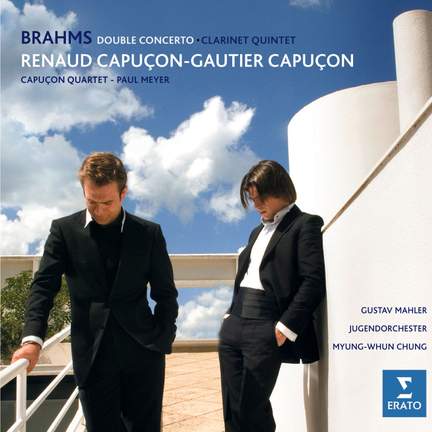
Special offer. Brahms: Double Concerto & Clarinet Quintet
Renaud Capuçon (violin) & Gautier Capuçon (cello), Paul Meyer (clarinet), Renaud Capuçon (violin), Aki Saulière (violin), Gautier Capuçon (cello) & Béatrice Muthelet (viola)
Gustav Mahler Jugendorchester, Myung-Whun Chung
Awards:
-
Gramophone Magazine, February 2008, Editor's Choice

-
Building a Library, October 2022, Recommended Recording

The stellar young Capuçon brothers seem incapable of setting a foot wrong on disc and they put their considerable chamber-music experience to great use in Brahms's final orchestral work, with...
Special offer. Brahms: Double Concerto & Clarinet Quintet
Renaud Capuçon (violin) & Gautier Capuçon (cello), Paul Meyer (clarinet), Renaud Capuçon (violin), Aki Saulière (violin), Gautier Capuçon (cello) & Béatrice Muthelet (viola)
Gustav Mahler Jugendorchester, Myung-Whun Chung
Purchase product
Awards:
-
Gramophone Magazine, February 2008, Editor's Choice
-
Building a Library, October 2022, Recommended Recording
The stellar young Capuçon brothers seem incapable of setting a foot wrong on disc and they put their considerable chamber-music experience to great use in Brahms's final orchestral work, with...
About
Contents and tracklist
Work length25:53
This work is only available as an album download.
I. Allegro
Track length18:05
This track is only available as an album download.
Work length2:56
Work length37:29
This work is only available as an album download.
- Gautier Capuçon (cello), Paul Meyer (clarinet), Renaud Capuçon (violin), Aki Saulière (violin), Béatrice Muthelet (viola)
I. Allegro
Track length12:48
This track is only available as an album download.
II. Adagio
Track length11:10
This track is only available as an album download.
Awards and reviews
-
Gramophone MagazineFebruary 2008Editor's Choice
 2010
2010
The stellar young Capuçon brothers seem incapable of setting a foot wrong on disc and they put their considerable chamber-music experience to great use in Brahms's final orchestral work, with cellist Gautier Capuçon proving an eloquent lead in the vehement first movement.
The other striking aspect about this performance is the sheer range of colour, not only from the soloists but also from the Gustav Mahler Youth Orchestra, who play their hearts out for Myung-Whun Chung in this most symphonic of concertos. If Oistrakh and Fournier are still irresistible in the slow movement, offering a perfect balance of melodic lines that are lovingly cherished but never saccharine, the Capuçons are still very impressive, and their finale is full of vitality, making much of the folk-tinged inflections and achieving a seemingly telepathic unanimity in their shared passages.
For a change from the usual concerto companion we get Brahms's Clarinet Quintet, written in 1891, four years after the Double Concerto. In this coupling it's easy to hear the Quintet's famous autumnal quality prefigured in the outer sections of the concerto's Andante.
Paul Meyer is an ideal protagonist, producing a wide array of mellow shadings in the opening movement, yet never underplaying the more agitated passages within the piece, notably the Presto of the third movement. The quartet are minutely responsive to Meyer's every move and even seasoned Brahms aficionados will find new detail to relish in both the performances here.
Here is a Double Concerto to listen to again and again. Not least because it is rather unusual. The Capuçon brothers are accomplished chamber musicians and they often dig into this music as though in a chamber concert, taking time to explore, passing ideas between themselves. It doesn’t displace the recent Fischer/Müller-Schott, but sits alongside
 February 2008
…here's a very fine reading of Brahm's Double Concerto from the stellar young Capuçon brothers. The other striking aspect about this performance is the sheer range of colour, not only from the soloists but also from the Mahler Youth Orchestra, who play their hearts out for Myung-Whun Chung in this most symphonic of concertos.

Gautier Capuçon launches into the opening cello solo with a rhapsodic freedom and expressive abandon that seems to sweep all before it. The performance is outstanding