Brahms: Symphony No. 4 & Hungarian Dances (selection)
London Philharmonic Orchestra, Marin Alsop
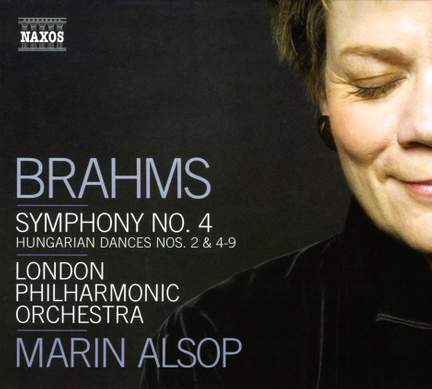
It's a rhythmically taut, finely structured reading with plenty of dynamism and thrust, but giving full rein to the work's deep elegiac aspects and darker shadings.
Brahms: Symphony No. 4 & Hungarian Dances (selection)
London Philharmonic Orchestra, Marin Alsop
Purchase product
It's a rhythmically taut, finely structured reading with plenty of dynamism and thrust, but giving full rein to the work's deep elegiac aspects and darker shadings.
About
Contents and tracklist
- London Philharmonic Orchestra
- Marin Alsop
- Recorded: 21-22 March 2005
- Recording Venue: Blackheath Concert Hall, London, UK
- London Philharmonic Orchestra
- Marin Alsop
- Recorded: 22-23 April 2006
- Recording Venue: The Colosseum, Town Hall, Watford, UK
Awards and reviews
 October 2007
It's a rhythmically taut, finely structured reading with plenty of dynamism and thrust, but giving full rein to the work's deep elegiac aspects and darker shadings.
 2010
2010
The LPO, London's finest Brahms ensemble, has been in vintage form during this cycle under Marin Alsop's measured and thoughtful direction.
Not since the classically incisive Loughran/ Hallé recordings of the mid-1970s has there been a more obviously collectable budget-price Brahms set.
Alsop's reading of the Fourth Symphony is not dissimilar to Sir Adrian Boult's 1972 LPO recording. Like Boult, Alsop is happy to establish a tempo and emotional trajectory for each movement and leave it at that – a plausible view given the astonishing degree of thematic integration that underpins the work.
As elsewhere in the cycle, tempi tend to be measured.
The Andante moderato is downright slow, though Alsop manages to maintain line and interest.
The Scherzo, happily, is a true Allegro giocoso, which is important. By acting out the role of a conventional finale, the Scherzo leaves the actual finale free to enact its own tragic destiny.
The recording sounds well if played at a decent level. In the Scherzo, the triangle (deliciously placed and recorded in the Hungarian Dances) is more an impression than a presence. There is also an editing glitch midway through the movement, not the first in this series. The seven Hungarian Dances, unorchestrated by Brahms, are heard in newly commissioned orchestrations by Peter Breiner. The thudding fairground timpani in No 6 doesn't appeal. Elsewhere, piquancy is the watchword, with stylish playing from the LPO, gamesomely led.
 February 2008
The LPO, London's finest Brahms ensemble, has been in vintage form during this cycle under Marin Alsop's measured and thoughtful direction.

Alsop’s triumphant cycle of Brahms symphonies with the LPO comes to a climactic end with this hugely impressive account of the Fourth. She has that ability, vital in music as dense as this, to hurry nothing, to make the most of the moment, yet always to maintain a sense of impetus.