Richard Strauss - Complete Works for Wind Ensemble
Royal Academy of Music Symphonic Wind, Keith Bragg
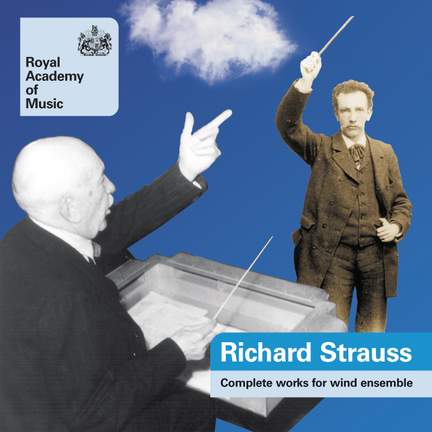
the standard is, as we have come to expect, extraordinarily high
Richard Strauss - Complete Works for Wind Ensemble
Royal Academy of Music Symphonic Wind, Keith Bragg
Purchase product
the standard is, as we have come to expect, extraordinarily high
About
Contents and tracklist
Strauss, R:
Sonatina No. 1 in F Major, TrV 288, "Aus der Werkstatt eines Invaliden"
Work length30:57
- Royal Academy of Music Symphonic Wind Ensemble
- Keith Bragg
- Recorded: June 2005
- Recording Venue: Duke's Hall, Royal Academy of Music, London, UK
- Royal Academy of Music Symphonic Wind Ensemble
- Keith Bragg
- Recorded: October 2006
- Recording Venue: Duke's Hall, Royal Academy of Music, London, UK
- Royal Academy of Music Symphonic Wind Ensemble
- Keith Bragg
- Recorded: October 2006
- Recording Venue: Duke's Hall, Royal Academy of Music, London, UK
- Royal Academy of Music Symphonic Wind Ensemble
- Keith Bragg
- Recorded: January 2003
- Recording Venue: Duke's Hall, Royal Academy of Music, London, UK
Awards and reviews
 January 2004
the standard is, as we have come to expect, extraordinarily high
 2010
2010
Strauss wrote his Serenade in E flat for 13 instruments in 1881, when he was only 17. It is essentially Mozartian in derivation, yet immediately the ear registers the romantic swing of the melodies and the lusher textures which make the Straussian imprint. Already the young composer's textural blending is masterly, while the sonorities anticipate the future.
The four-movement Suite in B flat (also for 13 instruments) is more diverse and further removed from Mozart, with a tender Romanze (with rich horns), a good-natured Gavotte and a finale which begins in mock darkness before setting off into a jolly, robust fugue.
The two major works date from his last years and show him in full maturity. Extra instruments were added to the Symphony in F – a C clarinet, basset-horn and bass clarinet – and the full sonority is quite luscious, the lines even more melodically complex. The Symphony in E flat dates from 1945 and on its title-page the composer wrote 'To the divine Mozart at the end of a life full of gratitude'. It seems to take off from where the previous symphony finished, the opening glowingly animated and vivacious and – as played here – with exuberant forward thrust.
The delicate Andantino has appealing classical grace and the Minuet seems good-naturedly bucolic, yet produces an engaging tune for the horns, taken up by the solo clarinet. The finale quotes from Götterdämerung but spirits soon lift; the allegro sets off with light-hearted lyricism, with swiftly intertwining woodwind, and the music gathers force and momentum to reach its spectacular, life-asserting coda.

Strauss's wonderful wind works delivered by a polished Academy band… It's a magnificent performance, but all four works here are superbly and spontaneously played by eager musicians from the Royal Academy of Music who provide wonderful
blending and a superbly polished, professional ensemble under their fine conductor, Keith Bragg. This new set certainly trumps its rivals.