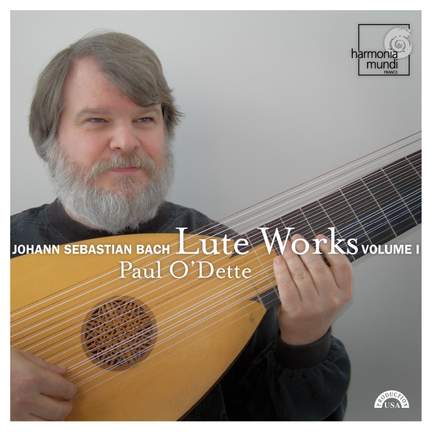
Bach - Lute Works Volume 1
Paul O'Dette (13-course Baroque lute by Andrew Rutherford, New York, 2002, after Sebastian Schelle)
Awards:
-
BBC Music Magazine, September 2007, Instrumental Choice

The pieces here are expanded arrangements, largely by Bach himself, of music for solo cello and violin… O'Dette responds magnificently, playing with a sense of total ease - fluent, expressive,...
Bach - Lute Works Volume 1
Paul O'Dette (13-course Baroque lute by Andrew Rutherford, New York, 2002, after Sebastian Schelle)
Purchase product
Awards:
-
BBC Music Magazine, September 2007, Instrumental Choice
The pieces here are expanded arrangements, largely by Bach himself, of music for solo cello and violin… O'Dette responds magnificently, playing with a sense of total ease - fluent, expressive,...
About
Johann Sebastian Bach so admired the sound of the lute that he designed a gut-strung harpsichord to imitate it (Lautenwerk) which ‘deceived the ears of the best lutenists’. This invention permitted him, as a keyboard virtuoso, to compose astonishing pieces for ‘lute’ that are unplayable on the 13-course instruments of his day! Paul O’Dette has taken up this challenge, introducing into these arrangements of suites and partitas just what was needed to make them sound natural on his instrument.
All works arranged by Paul O'DetteContents and tracklist
Awards and reviews
-
BBC Music MagazineSeptember 2007Instrumental Choice
 September 2007
The pieces here are expanded arrangements, largely by Bach himself, of music for solo cello and violin… O'Dette responds magnificently, playing with a sense of total ease - fluent, expressive, sensitively balancing contrapuntal lines.
 2010
2010
Bach never wrote directly for lute; his works for the instrument are transcriptions from his preexisting music or were written for the lute-harpsichord (Lautenwerk), an instrument designed to imitate the lute. The A minor Suite, BWV995, Pièces pour la Luth à Monsieur Schouster, is an arrangement of the Cello Suite BWV1011; the Partita in E major is an arrangement of the Partita BWV1006 for solo violin, transposed to F major. The Sonata in G minor is an arrangement by O'Dette of the Sonata in G minor for solo violin BWV1001, modelled after the arrangement of its fugue for lute by Johann Christian Weyrauch, a friend of Bach's.
A direct comparison with Hopkinson Smith's magisterial readings (Astrée) is revealing. He treats the dance in the abstract. His pulse is flexible, his expressive shading copious. O'Dette is determined to restore the dance proper. The rhythmic outlines are sharply defined by a judicious use of staccato bass notes and extensive employment of notes inégales and other Frenchstyle embellishments. That's not to say that O'Dette isn't alive to a more improvisatory quality, especially in the preludes and the Sonata in G minor. But in short, with his readings, the body dances; with Smith's, the soul. Neither approach is superior to the other – it's merely a matter of emphasis.