Strauss, R: Elektra
Jean Madeira, Inge Borkh, Lisa Casa, Max Lorenz, Kurt Böhme, Alois Pernerstorfer, Anny Felbermayer, Karol Loraine, Erich Majkut, Georg Littasy, Audrey Gerber
Wiener Philharmoniker, Chor der Wiener Staatsoper, Dimitri Mitropoulos
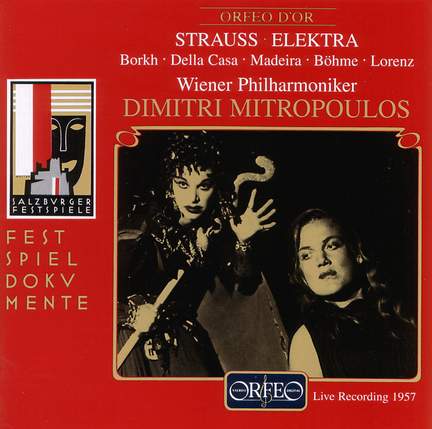
This is an enthralling performance. Mitropoulos made a speciality of the score, his most important contribution to opera interpretation.
Souvenirs exist of his performances at the Met in 1949...
Strauss, R: Elektra
Jean Madeira, Inge Borkh, Lisa Casa, Max Lorenz, Kurt Böhme, Alois Pernerstorfer, Anny Felbermayer, Karol Loraine, Erich Majkut, Georg Littasy, Audrey Gerber
Wiener Philharmoniker, Chor der Wiener Staatsoper, Dimitri Mitropoulos
Purchase product
This is an enthralling performance. Mitropoulos made a speciality of the score, his most important contribution to opera interpretation.
Souvenirs exist of his performances at the Met in 1949...
About
Contents and tracklist
- Sonja Draksler, Audrey Gerber, Inge Borkh, Lisa della Casa, Jean Madeira, Kurt Böhme, Max Lorenz
- Wiener Philharmoniker
- Dimitri Mitropoulos
Awards and reviews
 2010
2010
This is an enthralling performance. Mitropoulos made a speciality of the score, his most important contribution to opera interpretation.
Souvenirs exist of his performances at the Met in 1949 and at the Maggio Musicale in Florence in 1950, but his Salzburg reading is the one to have. No other conductor, not even Böhm or Solti in the studio, quite matches the frisson of this overwhelming account. And it confirms that Inge Borkh is indeed the most comprehensively equipped soprano for the title-role, vocally secure – high-C apart – and emotionally capable of fulfilling every demand of the strenuous part.
In the great scene with Orestes she first expresses ineffably the sorrow at his supposed death, the 'tausendmal' and 'nie wiederkommt' passage done with such a searing sense of loss; then comes the great release of recognition – sung with immense warmth – followed by another almost silvery voice as Elektra recalls her lost beauty. It's a passage of singing to return to repeatedly for its many insights. Chrysothemis finds in della Casa an unusual interpreter, wonderfully ecstatic and pure of voice if not as emotionally involving as some. Madeira is a formidable Klytemnestra, her nightmarish thoughts expressed in a firm voice, accurately deployed.
Böhme, a real bass, presents an implacable, angry Orestes, not as subtle or as sympathetic as Krause for Solti. Lorenz's fading Heldentenor is ideal to express Aegisthus's fatuity. And the maids have never, surely, been cast with such secure voices.
Inevitably, cuts are made as is almost always the case in the theatre where, otherwise, Elektra might be left voiceless by the end. If you want the complete score, the famous Solti set will do very nicely. If you want Borkh, you must choose between the Böhm in stereo (DG) or this unique experience.