Special offer. 'Cav and Pag'
May Blyth (Santuzza), Heddle Nash (Turiddu), Harold Williams (Alfio), Frank Mullings (Canio), Miriam Licette (Nedda), Harold Williams (Tonio), Heddle Nash (Beppe), Dennis Noble (Silvio)
British National Opera Company, Aylmer Buesst, Eugene Goossens
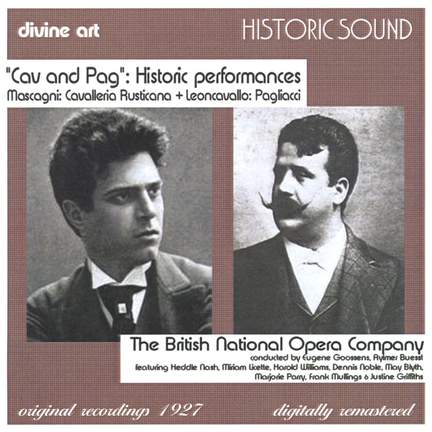
As Andrew Rose, the man responsible for this transfer, points out, there was a period when Columbia records were known for their 'silent surfaces', and happily he has had access to early copies...
Special offer. 'Cav and Pag'
May Blyth (Santuzza), Heddle Nash (Turiddu), Harold Williams (Alfio), Frank Mullings (Canio), Miriam Licette (Nedda), Harold Williams (Tonio), Heddle Nash (Beppe), Dennis Noble (Silvio)
British National Opera Company, Aylmer Buesst, Eugene Goossens
Purchase product
As Andrew Rose, the man responsible for this transfer, points out, there was a period when Columbia records were known for their 'silent surfaces', and happily he has had access to early copies...
About
There are countless recordings of "Cav and Pag" but few as special as these. Made in 1927, these were the first complete opera recordings made in the UK by the electric process. Quite simply, they still rank as among the best recordings of these popular short operas ever made, and are now issued on CD in fine restored sound for the first time.
recorded in 1927Contents and tracklist
- Heddle Nash (tenor), Harold Williams (baritone), May Blyth (soprano), Marjorie Parry (mezzo-soprano), Justine Griffiths (contralto)
- British National Opera Company Chorus, British National Opera Company Orchestra
- Aylmer Buesst
- Recorded: 1927
- Dennis Noble (baritone), Heddle Nash (tenor), Harold Williams (baritone), Miriam Licette (soprano), Franks Mullings (tenor)
- British National Opera Company Chorus, British National Opera Company Orchestra
- Eugene Goossens
- Recorded: 1927
Awards and reviews
 2010
2010
As Andrew Rose, the man responsible for this transfer, points out, there was a period when Columbia records were known for their 'silent surfaces', and happily he has had access to early copies of the originals from this period. The clarity and immediacy of sound reveal performances which at best give pleasure by any standards and, at less than that, are fascinating as period documents.
In Cav the violin-playing does credit to nobody, yet this loose, slithery style must then have been acceptable, even 'authentic'. In Pag the male chorus sings with unabashed gusto in tones that (inaccurately no doubt) we tend to call 'beery'. Then the pronunciation is very much of its period, every 'r' rolled (as in 'charrm') and the 'I' sounds (Nash was a great one for this) shaded to 'Ae'. The translations represent the kind of thing the current 'Opera in English' series on Chandos is keen to avoid: a favourite is Nedda's beautifully enunciated 'For such a passion / The whip is the fashion'. But there's fine singing, and not only from Nash. Harold Williams, a little shy of the high notes, is splendidly firm and resonant in both operas. Miriam Licette is a very un-Italian Nedda but her 'take' of the high notes is distinctly that of a Marchesi pupil.
Similarly, May Blyth is a lightweight Santuzza but still provides much to admire. Of Mullings's Canio, the throatiness and discomfort in the upper range are to some extent offset by a warmly personal timbre and intense dramatic commitment.
The Pagliacci also suffers from moments of distortion due to overloading on the originals.
The Cav suffers from a somewhat hectic rush to get everything on to the 10-inch disc. And it is notable that the orchestra pulls up its metaphorical socks for Eugene Goossens.