Jacob - Symphonies Nos. 1 & 2
London Philharmonic Orchestra, Barry Wordsworth
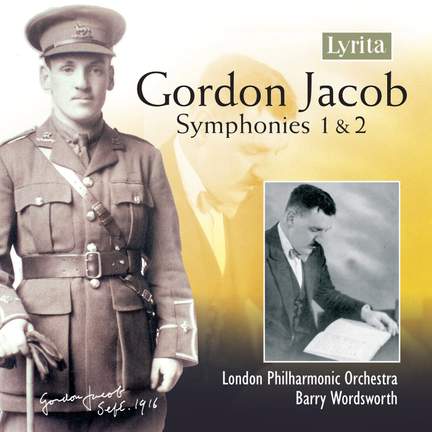
Gordon Jacob's First Symphony (1929) employs sizeable forces (including triple woodwind and two harps) and has five movements: two feisty and purposeful Allegros frame the whole edifice, while...
Jacob - Symphonies Nos. 1 & 2
London Philharmonic Orchestra, Barry Wordsworth
Purchase product
Gordon Jacob's First Symphony (1929) employs sizeable forces (including triple woodwind and two harps) and has five movements: two feisty and purposeful Allegros frame the whole edifice, while...
About
Contents and tracklist
Awards and reviews
 2010
2010
Gordon Jacob's First Symphony (1929) employs sizeable forces (including triple woodwind and two harps) and has five movements: two feisty and purposeful Allegros frame the whole edifice, while its dashing central Scherzo is flanked by two slow movements, the first of which in particular possesses an elegiac demeanour that accords with the work's inscription to the memory of the composer's favourite brother, Anstey (a victim of the First World War – Jacob, too, served in the trenches). It would make a terrific 'Guess who?' item: on a first encounter the names of Vaughan Williams, Holst, Elgar, Walton, Bliss, Poulenc and Stravinsky might appear. The more you return to it, however, the more individual the voice that emerges. Barry Wordsworth lends this powerful, criminally neglected discovery clearheaded, fervent advocacy, and the LPO are on their toes throughout. Completed in 1945, the Second Symphony was premiered under Boult in a May 1946 broadcast; Rudolf Schwarz gave the first public performance two years later. Cast in the traditional four movements and described by Jacob as 'a meditation on war, suffering and victory', it's tautly argued, full of healthy contrapuntal vigour (at times it calls to mind Nielsen) and concludes with a cleverly crafted passacaglia or 'Ground' – perhaps subconsciously influenced by, and yet fascinatingly different from, the finale of Vaughan Williams's roughly contemporaneous Fifth Symphony. These performers bring great tonal heft and intensity (especially in the plangent slow movement), admirably serving this bracing music.
With its agreeably tangible and airy sound in the best Lyrita tradition, this stimulating pairing of two impressive British symphonies merits immediate investigation.
 September 2007
Gordon Jacob's First Symphony (1929) employs sizeable forces… two feisty and purposeful Allegros frame the whole edifice, while its dashing central Scherzo is flanked by two slow movements, the first of which in particular possesses an elegiac demeanour... Barry Wordsworth lends this powerful, criminally neglected discovery clear-headed, fervent advocacy, and the LPO are on their toes throughout. ...the Second Symphony... described by Jacob as "a meditation on war, suffering and victory", it's tautly argued, full of healthy contrapuntal vigour... and concludes with a cleverly crafted passacaglia of "Ground"... Comparison with Bostock's rival account finds these newcomers generating the greater tonal heft and intensity...
 August 2012
[Wordsworth] does a nice job with these two symphonies. The low brass can get heavy in their melodic phrases in the Second Symphony, where ensemble sounds marginally less secure than in the rock-solid First, but overall the LPO plays handsomely and with commitment. The recording - an original digital production, unlike some other Lyrita releases - is vivid and colourful, with rich, deep brass reproduction