Schütz - Opus Ultimum
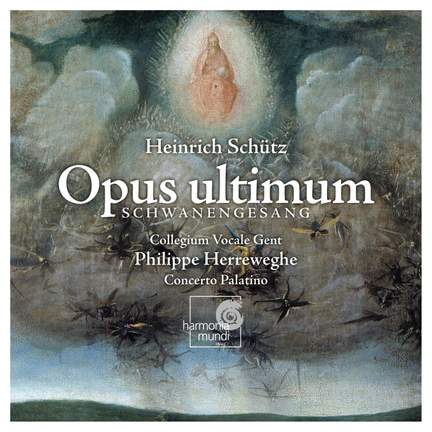
Concerto Palatino & Collegium Vocale Gent, Philippe Herreweghe
Awards:
-
Presto Recording of the Week, 7th May 2007

-
Gramophone Magazine, June 2007, Editor's Choice

If not texturally pared down, this is a journey where the 86-year-old Schütz withdraws from the world in a lexicon of finely drawn plainchants, antique modes, taut contrapuntal and antiphonal...
Schütz - Opus Ultimum
Concerto Palatino & Collegium Vocale Gent, Philippe Herreweghe
Purchase product
Awards:
-
Presto Recording of the Week, 7th May 2007
-
Gramophone Magazine, June 2007, Editor's Choice
If not texturally pared down, this is a journey where the 86-year-old Schütz withdraws from the world in a lexicon of finely drawn plainchants, antique modes, taut contrapuntal and antiphonal...
About
The swansong of Heinrich Schütz.
In the early 1660s, Schütz, now relegated among the faded glories of the Dresden court, began to prepare for the idea of his own death - he was now more than 65 years old... He embarked on a setting of all 176 verses of Psalm 119, without necessarily expecting the resulting work to be performed: his swansong was conceived for all eternity. Ten years later, this Opus ultimum had assumed the form of 11 motets for double choir. Since the manuscripts were dispersed after his death, it was to be another three centuries before the work was reconstructed - and then sung!
Contents and tracklist
Spotlight on this release
-
Schütz's Legacy
7th May 2007
Philippe Herreweghe and Collegium Vocale Gent performed the German baroque master’s ‘Opus ultimum’, a series of eleven motets for double choir setting Psalm 119.

Awards and reviews
-
Presto Recording of the Week7th May 2007
-
Gramophone MagazineJune 2007Editor's Choice
 2010
2010
If not texturally pared down, this is a journey where the 86-year-old Schütz withdraws from the world in a lexicon of finely drawn plainchants, antique modes, taut contrapuntal and antiphonal exchanges, melodic swathes and quicksilver declamations.
Herreweghe illuminates each verse with a considered and gentle ear for the progression from the 'statutes' of faith towards a sense of hope and salvation as we move towards a new Covenant, revealed in the final motet with its assuaging supplications and rock-like assurance.
Here we sense, above all, Schütz's mix of defiance and resignation for the gradual passing of a selfcontained sacred tradition threatened by radical worldly things (like operas).
Collegium Vocale relish Schütz's introspection and easy exchange between solo and tutti sections, which allow the inspired rhetorical mood-changes to reveal each marked-out image ('when thou shalt enlarge my heart' at the end in the second motet is dealt a moment of special attention as it moves towards a conclusion in rapt homage to Monteverdi). Herreweghe's performances are generally outstanding in their attention to detail: some might quibble that the inner tutti voices occasionally lack focus and energy, but this is a performance where Schütz's seasoned harmonic shifts are treated as pure music and not over-accentuated by rhetorical zeal: the music doesn't need it. Can a greater work have been completed by an octogenarian? This recording urges us, very persuasively, to think perhaps not.
 June 2007
…the beauty of this remarkable performance of Schütz's last work resides principally in Collegium Vocale's blooming cradle of sound and how is unassumingly stakes its claim… on the unique ambitions of Schütz's "Swansong". …the doubling of the two four-part choirs with brass gives Herreweghe scope for a variety and scale which ensures that graphic representation emerges from a palette of irradiating luxuriance.