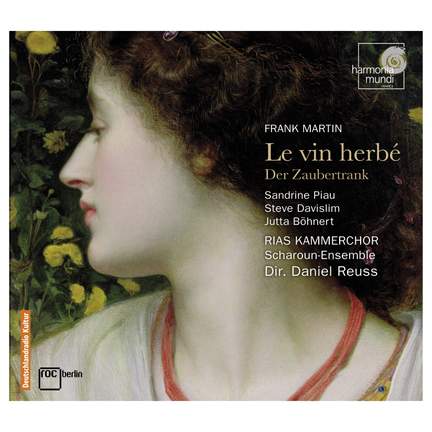
Martin, F: Le Vin Herbé
Sandrine Piau (Iseut), Steve Davislim (Tristan), Jutta Böhnert (Branghien), Hildegard Wiedemann (Iseut aux Blanches Mains), Ulrike Bartsch (La Mère d'Iseult), Joachim Buhrmann (Kaherdin), Jonathan E. de la Paz Zaens (King Mark) & Roland Hartmann (Le Duc Hoël & Un Vieillard)
RIAS Kammerchor...
Awards:
-
Gramophone Magazine, July 2007, Editor's Choice

Daniel Reuss's… singers and instrumentalists show themselves completely attuned to this exalted score and sensitive to its luminous textures and powerful sense of mystery. The choir has perfect...
Martin, F: Le Vin Herbé
Sandrine Piau (Iseut), Steve Davislim (Tristan), Jutta Böhnert (Branghien), Hildegard Wiedemann (Iseut aux Blanches Mains), Ulrike Bartsch (La Mère d'Iseult), Joachim Buhrmann (Kaherdin), Jonathan E. de la Paz Zaens (King Mark) & Roland Hartmann (Le Duc Hoël & Un Vieillard)
RIAS Kammerchor...
Purchase product
Awards:
-
Gramophone Magazine, July 2007, Editor's Choice
Daniel Reuss's… singers and instrumentalists show themselves completely attuned to this exalted score and sensitive to its luminous textures and powerful sense of mystery. The choir has perfect...
About
Contents and tracklist
- Scharoun Ensemble Berlin, Daniel Reuss, Ulrike Bartsch, RIAS Kammerchor, Sandrine Piau, Jutta Böhnert, Steve Davislim
- Daniel Reuss, Scharoun Ensemble Berlin, RIAS Kammerchor, Jonathan de la Paz Zaens, Steve Davislim, Sandrine Piau
- Steve Davislim, RIAS Kammerchor, Daniel Reuss, Roland Hartmann, Scharoun Ensemble Berlin, Joachim Buhrmann, Sandrine Piau, Hildegard Wiedemann
Awards and reviews
-
Gramophone MagazineJuly 2007Editor's Choice
 May 2007
Daniel Reuss's… singers and instrumentalists show themselves completely attuned to this exalted score and sensitive to its luminous textures and powerful sense of mystery. The choir has perfect intonation and tonal blend. Expertly balanced recording too. In all, a wonderful issue.
 2010
2010
Scored for 12 voices, piano and string septet, Frank Martin's setting of the legend of Tristan and Isolde, with its very understated emotions, sparse texture and deliberately limited harmonic vocabulary, has enjoyed a somewhat chequered history on record.
The RIAS Chamber Choir bring rather more than 12 voices to this recording – including the eight principal solo roles, there are a total of 29 singers listed – but, unquestionably, they preserve the intimacy and directness of expression which is so essential in any performance of Le vin herbé. It is clearly not to enrich the overall body of sound that Daniel Reuss has brought in so many voices, but he has clearly selected them, both in ensemble and solo, with painstaking care to underline the essential character of each of the individual tableaux, and even at the most climactic moments, there are never more than a handful singing together.
Such an approach pays remarkable dividends in that it allows the three main sections of the work to focus more clearly on their very different specific human characteristics. In the first, 'The Love Potion', while their love may have been chemically induced, there is no doubting the sense of mutual affection and respect with which the calm stateliness of Steve Davislim and the unaffected poise of Sandrine Piau portray Tristan and Isolde. The second, 'The Forest of Morois', deals with compassion and forgiveness and Jonathan de la Paz Zaens' portrayal of King Mark exudes profound goodness in a way which sheds a totally new light on the word 'kingly'.
The third, 'Death', covers jealousy and reconciliation and Hildegard Wiedemann is utterly convincing in the somewhat difficult role of the vaguely treacherous Isolde of the White Hands.
Alongside all this runs a beautifully crafted instrumental accompaniment, far more involved in the drama than the booklet notes imply by suggesting that it is 'like the scenery in a play'. There is immense sensitivity in the way the individual members of the Scharoun Ensemble handle the amazingly fluid instrumental textures, the very understatedness of which drives the fundamental message home far more powerfully than a whole plethora of dramatic orchestral gestures. Driven along with a powerful sense of urgency by Reuss, this is an intense and deeply moving performance which, complete with lavish packaging and a superlative recorded sound, brings to the catalogue something which it has never had before; a really first-rate and compelling performance of this most important of Martin scores.
 July 2007
Driven along with a powerful sense of urgency by Reuss, this is an intense and deeply moving performance which… brings to the catalogue something which it has never had before; a really first-rate and compelling performance of this most important of Martin scores.

This Berlin-based recording is simply stupendous…The beautifully nuanced recorded sound caps an essential release for anyone interested in the forgotten byways of mid-20th-century music.