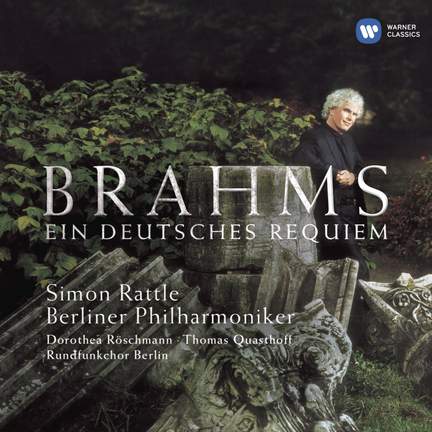
Brahms: Ein Deutsches Requiem, Op. 45
Dorothea Röschmann (soprano) & Thomas Quasthoff (baritone)
Berliner Philharmoniker & Rundfunkchor Berlin, Simon Rattle
Awards:
-
BBC Music Magazine, April 2007, Disc of the month

-
Gramophone Awards, 2007, Winner - Choral

-
Grammy Awards, 50th Awards (2007), Best Choral Performance

…this is a very impressive account of Brahms's German Requiem, deeply considered and most beautifully played and sung. The full, warm sound he draws from the Berlin Philharmonic has a sombre...
Brahms: Ein Deutsches Requiem, Op. 45
Dorothea Röschmann (soprano) & Thomas Quasthoff (baritone)
Berliner Philharmoniker & Rundfunkchor Berlin, Simon Rattle
Purchase product
Awards:
-
BBC Music Magazine, April 2007, Disc of the month
-
Gramophone Awards, 2007, Winner - Choral
-
Grammy Awards, 50th Awards (2007), Best Choral Performance
…this is a very impressive account of Brahms's German Requiem, deeply considered and most beautifully played and sung. The full, warm sound he draws from the Berlin Philharmonic has a sombre...
About
A major benchmark work of the choral tradition of which a significant new recording has not appeared for some years, this release is highly attractive to all markets and has the potential to become the definitive modern interpretation of this wonderfully powerful and moving work.
Contents and tracklist
Work length1:07:03
This work is only available as an album download.
I. Selig sind, die da Leid tragen
Track length9:55
This track is only available as an album download.
II. Denn alles Fleisch, es ist wie Gras
Track length14:14
This track is only available as an album download.
III. Herr, lehre doch mich
Track length9:13
This track is only available as an album download.
IV. Wie lieblich sind deine Wohnungen
Track length4:54
This track is only available as an album download.
V. Ihr habt nun Traurigkeit
Track length7:34
This track is only available as an album download.
VI. Denn wir haben hie keine bleibende Statt
Track length10:43
This track is only available as an album download.
VII. Selig sind die Toten
Track length10:30
This track is only available as an album download.
Spotlight on this release
-
An error occurred.
Try watching this video on www.youtube.com, or enable JavaScript if it is disabled in your browser.
Awards and reviews
-
BBC Music MagazineApril 2007Disc of the month
 April 2007
…this is a very impressive account of Brahms's German Requiem, deeply considered and most beautifully played and sung. The full, warm sound he draws from the Berlin Philharmonic has a sombre refulgence that becomes almost incandescent in the final movement's vision of the blessed dead. The vocal component is equally impressive, with beautiful choral singing. Thomas Quasthoff is an eloquent expounder of scripture in the baritone movements, Dorothea Röschmann ideally tender in 'Ihr habt nun Traurigkeit'.
 13th December 2007
The music comforts, calms, suggests hope, whilst still acknowledging the tragedy of death, and under Simon Rattle's baton the choir and orchestra have got to the heart of it; they bring out all the nuances of emotion, and one feels they really understand it...Dorothea Roschmann's beautiful, rich soprano voice delivers the impassioned tenderness the listener craves.
 2010
2010
This is a lovely performance, sensitive to the work's consolatory mood, free-moving and sweetly sung. Rattle's reading does not obscure Brahms's debt to Schütz, Bach and the other great pre-classical German Protestant composers, but it stresses more the work's roots in the new German school: to the influence, above all, of Brahms's cherished and much mourned mentor, Robert Schumann.
This is not a period performance in the sense of attempting to conjure forth period sounds.
The opening colloquy for violas and divided cellos is pure Berlin (Nikisch would have recognised the sound, as would the young Karajan).
The singing is awed and reverential, with ravishing pianissimi from the superb Berlin Radio Chorus. What we have here is not authenticity of sound but authenticity of feeling and effect.
Has there ever been a swifter performance of the fourth movement, 'Wie lieblich sind deine Wohnungen', or a more calming one? A flowing tempo which creates a sense of deep repose suggests that most sought-after of all qualities in an interpreter, the art that disguises art.
Throughout, Rattle strikes a shrewd balance between the work's affective nature and its narrative power. Tempi are brisk in the two movements with baritone solo which carry much of the work's doctrine. The great choral codas to the second, third and sixth movements are also superbly judged. In the great choral peroration to the penultimate movement, space is provided for the words to tell, as Brahms clearly intends.
Thomas Quasthoff, who seems a little out of sorts, is no match for Fischer-Dieskau on Klemperer's unignorably splendid recording (reviewed above); and Dorothea Röschmann's reedy tone and tight vibrato in 'Ihr habt nun Traurigkeit' may not appeal either. Still, the movement is so persuasively shaped that, heard in context, it, too, 'speaks' to us through the sonic squall. Internal balances between choir, soloists, and orchestra are generally well judged: apt to a performance which treats this great memorial prose poem with a mixture of acumen and affection that is entirely special.
Musical America October 2006
The manifold blessings of having probably the world's greatest symphony orchestra as one's hometown band include the recurring phenomenon of having almost excessively familiar works sound ever fresh and new. With our superlative Philharmonic that happened most recently October 26 with the German Requiem of Johannes Brahms conducted by Sir Simon Rattle … The prolonged hush from Berlin's sophisticated audience following the dying fall of the final notes in Berlin's Philharmonie spoke for itself.