Poulenc: Melodies
Christine Lajarrige (piano), Michel Piquemal (baritone)
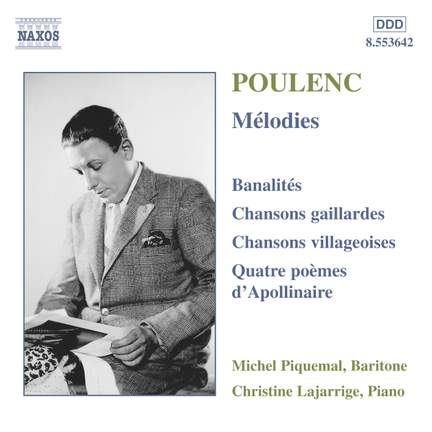
The first time Michel Piquemal met Pierre Bernac, for whom most of these songs were written, Piquemal recalls that Bernac said: 'I am very moved, because what you're doing is exactly what Francis...
Poulenc: Melodies
Christine Lajarrige (piano), Michel Piquemal (baritone)
Purchase product
The first time Michel Piquemal met Pierre Bernac, for whom most of these songs were written, Piquemal recalls that Bernac said: 'I am very moved, because what you're doing is exactly what Francis...
About
Contents and tracklist
- Christine Lajarrige (piano), Michel Piquemal (baritone)
- Christine Lajarrige (piano), Michel Piquemal (baritone)
- Christine Lajarrige (piano), Michel Piquemal (baritone)
- Christine Lajarrige (piano), Michel Piquemal (baritone)
- Christine Lajarrige (piano), Michel Piquemal (baritone)
- Christine Lajarrige (piano), Michel Piquemal (baritone)
- Christine Lajarrige (piano), Michel Piquemal (baritone)
- Christine Lajarrige (piano), Michel Piquemal (baritone)
- Christine Lajarrige (piano), Michel Piquemal (baritone)
- Christine Lajarrige (piano), Michel Piquemal (baritone)
Awards and reviews
 2010
2010
The first time Michel Piquemal met Pierre Bernac, for whom most of these songs were written, Piquemal recalls that Bernac said: 'I am very moved, because what you're doing is exactly what Francis Poulenc was hoping for. He would have been happy.' Afterwards Piquemal studied both with Bernac and Denise Duval, the two singers who were closest to the composer, so this recital is part of a real, authentic tradition. The greatest challenge for a singer comes in the bestknown songs, for instance Montparnasse and 'C'.
Piquemal doesn't disappoint. He hasn't got the luxurious voice for the lyrical climax of the first, at the words 'Vous êtes en réalité un poète lyrique d'Allemagne / Qui voulez connaître Paris,' but he delivers all the complicated Apollinaire verse in this and the cycle Banalités with a complete understanding of the necessary balance between stressing the irony and maintaining the strict forward-moving musical line.
The one group that wasn't composed for a light baritone is Chansons villageoises, which, although sung and recorded by Bernac, was intended for a Verdi baritone; 'Un tour de chant symphonique' Poulenc called it. Like Bernac, Piquemal doesn't have the opulent vocal quality here that Poulenc was looking for, but instead he has an actor's way with the words that brings personality and humour to a text such as the opening 'Chanson du clair tamis' – très gai et très vite in Poulenc's marking.
All the brilliance of Maurice Fombeure's poetry gains clarity from Piquemal's diction and sense of fun, while the ensuing sadness of 'C'est le joli printemps' and the macabre parable of 'Le mendiant' are sharply contrasted.
If you want to sample this disc, try Bleuet, and the 'sensitive lyricism' that Bernac wrote of. It's one of8 the saddest songs Poulenc composed, with its image of the young soldier, the blue referring to the uniform of the conscript who has seen such terrible things while he's still almost a child. It has to be sung 'intimately', wrote Poulenc; Bernac, however, thought that it should also be 'virile and serious'. The penultimate line in which the boy faces the reality – he knows death better than life – is sung by Piquemal with a natural feel for the simplicity of the poem, never overdoing the emphasis, and never becoming arch.
At Naxos's low price this is a first-rate introduction to Poulenc's songs, but more than that it's an example of the best kind of French singing.
Christine Lajarrige is a sensitive accompanist, for Poulenc always acknowledged that his songs are duets, for voice and piano.

Michel Piquemal's Poulenc recital on Naxos is a real bargain, and a superb introduction to the composer's melodies. Piquemal gained the confidence of Pierre Bernac early in his career, and Bernac told him that his way with Poulenc's music would have made him happy.