Vladimir Horowitz
The Complete European Solo Recordings 1930-36
Vladimir Horowitz (piano)
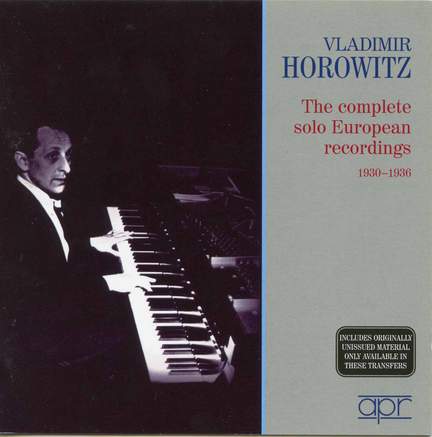
Self-respecting pianophiles will already have most of these seminal recordings. But, compared with earlier issues, APR reveal a fuller, richer piano sound where every nuance is crystal clear...
Vladimir Horowitz
The Complete European Solo Recordings 1930-36
Vladimir Horowitz (piano)
Purchase product
Self-respecting pianophiles will already have most of these seminal recordings. But, compared with earlier issues, APR reveal a fuller, richer piano sound where every nuance is crystal clear...
About
Contents and tracklist
Awards and reviews
Classic CD
Self-respecting pianophiles will already have most of these seminal recordings. But, compared with earlier issues, APR reveal a fuller, richer piano sound where every nuance is crystal clear and in a judiciously-enhanced ambience…APR's presentation,as usual, leaves its peers standing, fully worthy of the great artist enshrined in these magical recordings
 2010
2010
Horowitz's 1930-36 European recordings are beyond price, and so it's more than gratifying to have them permanently enshrined on APR rather than fleetingly available elsewhere. This is notably true of Horowitz's legendary, forever spine-tingling 1932 recording of the Liszt Sonata. Here, once more, is that uniquely teasing and heroic sorcery with octaves and passagework that blaze and skitter with a manic force and projection; an open defiance of all known musical and pianistic convention. Horowitz's virtuosity, particularly in his early days, remains a phenomenon, and hearing, for example, the vivamente elaboration of the principal theme or the octave uproar preceding the glassy, retrospective coda is to be reminded of qualities above and beyond the explicable. His way with the Chopin Mazurkas unites their outer dance elements and interior poetry with a mercurial brilliance and idiosyncrasy, and who but Horowitz could use his transcendental pianism to conjure a commedia dell'arte vision of such wit and caprice in Debussy's Etude, Pour les arpègescomposés? Of the previously unpublished recordings, the first movement from Chopin's Second Sonata is as macabre and tricky as ever, with a steady, oddly menacing tempo. Prokofiev's Toccata, on the other hand, is tossed off at a nail-biting speed, and not even a small but irritating cut, a wild, approximate flailing at the end and an added chord by way of compensation, can qualify the impact of such wizardry. In Rachmaninov's G minor Prelude, however, Horowitz's volatility gets the better of him. If Horowitz, in common with virtually every other pianist, was not equally convincing in every composer and was even 'a master of distortion' for some, he was a Merlin figure of an indelible, necromantic brio for all others.
Though expertly transferred, they do show their age somewhat, but nothing can lessen the impact of Horowitz's early charisma.