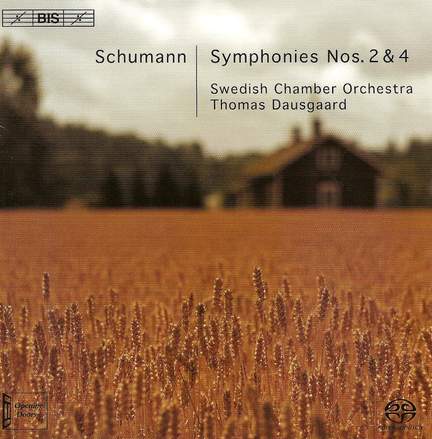
Schumann - Symphonies Nos. 2 & 4
Swedish Chamber Orchestra, Thomas Dausgaard
Awards:
-
BBC Music Magazine Awards, 2008, Orchestral Finalist

Dausgaard is not the first conductor to use the 1841 version of the D minor Symphony… but… this performance, given by an orchestra of the size of Schumann himself would have known brings it...
Schumann - Symphonies Nos. 2 & 4
Swedish Chamber Orchestra, Thomas Dausgaard
Purchase product
Awards:
-
BBC Music Magazine Awards, 2008, Orchestral Finalist
Dausgaard is not the first conductor to use the 1841 version of the D minor Symphony… but… this performance, given by an orchestra of the size of Schumann himself would have known brings it...
About
Contents and tracklist
Work length35:29
- Swedish Chamber Orchestra
- Thomas Dausgaard
- Recorded: March 2006
- Recording Venue: Orebro Concert Hall, Sweden
I. Sostenuto assai - Allegro ma non troppo
Track length11:46
II. Scherzo. Allegro vivace
Track length6:46
III. Adagio espressivo
Track length9:21
IV. Allegro molto vivace
Track length7:36
Schumann:
Scenes from Goethe's Faust, Scenen aus Goethes Faust, WoO 3
Work length7:46
- Swedish Chamber Orchestra
- Thomas Dausgaard
- Recorded: March 2005
- Recording Venue: Orebro Concert Hall, Sweden
Overture
Track length7:46
Schumann:
Julius Cesar Overture, Op. 128
Work length8:32
- Swedish Chamber Orchestra
- Thomas Dausgaard
- Recorded: March 2006
- Recording Venue: Orebro Concert Hall, Sweden
Work length24:04
- Swedish Chamber Orchestra
- Thomas Dausgaard
- Recorded: March 2006
- Recording Venue: Orebro Concert Hall, Sweden
I. Andante con moto - Allegro di molto (Original Version, 1841)
Track length8:11
II. Romanza. Andante (Original Version, 1841)
Track length3:45
III. Scherzo. Presto (Original Version, 1841)
Track length6:12
IV. Largo - Finale. Allegro vivace (Original Version, 1841)
Track length5:56
Awards and reviews
 April 2007
Dausgaard is not the first conductor to use the 1841 version of the D minor Symphony… but… this performance, given by an orchestra of the size of Schumann himself would have known brings it vividly to life. Even more impressive… is the C major Second Symphony. ...the first and last movements - the latter taken at a tremendous speed - are electrifying. As for the Adagio - the most heartrendingly beautiful piece of its kind between Schubert and Bruckner - it is quite wonderfully played, with a spellbinding pianissimo sound for its central fugato passage.
 2010
2010
All this talk of Schumann's stodgy orchestral writing…Rubbish! Evidence for the defence is simple: keep the orchestra slim and well balanced, the tempi lively and the textures clear and the calories positively fall away. Thomas Dausgaard, with just 38 players, turns the symphonic Schumann into a thoughtful athlete who burns energy while his mind spins.
Dausgaard opts for the 1841 original version of the Fourth Symphony, with its faltering, even abrupt, transition from an opening Andante to a fleet Allegro. It leaves a very different impression to the revision. The transition from Scherzo to finale is much as it is in the familiar 1851 version but the finale itself contains 'new' material and neither of the outer movements has repeats. All in all, it is less thick-set than its successor: Brahms preferred it.
The Second Symphony is similarly revealing with keen accents and prominent inner voices, the latter half of the slow introduction biting and muscular, the main Allegro superbly built. In the Scherzo Dausgaard slows and softens the bridge passage appealingly, accentuating the dizzy flight back to the main subject. In the achingly beautiful Adagio, top line and accompaniment seem to lean on each other to ease the pain, and in speeding for the finale's second set Dausgaard intensifies the argument, making fresh sense of it.
BIS's realistic sound quality helps the clarifying process and the timps (with hard sticks) have tremendous presence. A good idea, too, to include Schumann's Julius Caesar and Faust overtures: strange, relatively late essays, equivocal music, slightly unhinged and played – appropriately enough – with a restless, slightly nervous edge.

the playing throughout is first-rate, with often dazzling, thrilling faster movements, but also some beautifully shaped, tender slower music, and a real feeling for the emotional extremes that are at the heart of Schumann’s art.