Special offer. American Classics - Ned Rorem
Fibonacci Sequence
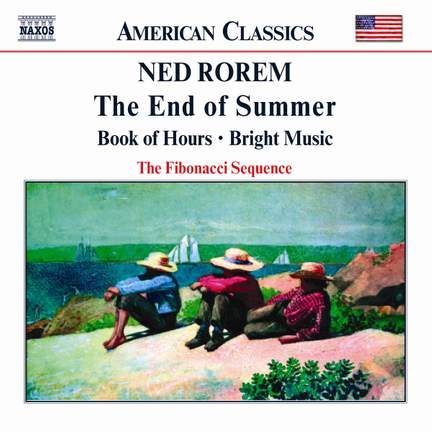
In Ned Rorem's End of Summer (1985) for clarinet, violin and piano, dramatic juxtapositions seem to be the work's organising principle.
Without postmodern trickery, Rorem shows us that seemingly...
Special offer. American Classics - Ned Rorem
Fibonacci Sequence
Purchase product
In Ned Rorem's End of Summer (1985) for clarinet, violin and piano, dramatic juxtapositions seem to be the work's organising principle.
Without postmodern trickery, Rorem shows us that seemingly...
About
Contents and tracklist
- Fibonacci Sequence
- Recorded: 26th-28th Oct, 2001
- Recording Venue: Potton Hall, Suffolk, England
- Fibonacci Sequence
- Recorded: 26th-28th Oct, 2001
- Recording Venue: Potton Hall, Suffolk, England
- Fibonacci Sequence
- Recorded: 26th-28th Oct, 2001
- Recording Venue: Potton Hall, Suffolk, England
Awards and reviews
 2010
2010
In Ned Rorem's End of Summer (1985) for clarinet, violin and piano, dramatic juxtapositions seem to be the work's organising principle.
Without postmodern trickery, Rorem shows us that seemingly disparate elements can coexist quite happily. One hears a similar kind of musical détente going on in parts of Bright Music (1987) for flute, two violins, cello and piano – particularly in the opening Fandango, inspired by the image of a rat inside a rubbish bin. This is a substantial, delightful suite, centered on a brilliant scherzo movement ('Dance-Song-Dance') that enfolds one of Rorem's loveliest tunes. The slow movement (entitled 'Another Dance') is an expansive, aching song without words, and the whirlwind finale a clever and ultimately unsettling take on the last movement of Chopin's Funeral March Sonata.
Book of Hours (1975), for flute and harp, is structured on the timetable of monastic prayer, beginning with Matins and continuing through Lauds all the way to Vespers and Compline.
There are few sweet melodies here, though Rorem's language is always expressive. 'Sext (Noon)' is especially touching, with the flute's shakuhachi-like glissandi sighing over the harp's exquisitely fragile song.
The performances by the Fibonacci Sequence are consistently polished and persuasive.
Clear recording, too, though the instruments are placed very close to the microphones.
Very strongly recommended.