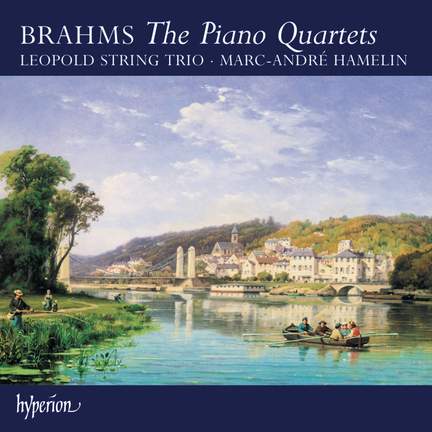
Brahms - The Piano Quartets
Marc-André Hamelin (piano)
Leopold String Trio
Awards:
-
Gramophone Awards, 2007, Finalist - Chamber

-
BBC Music Magazine, February 2007, Chamber Choice

Brahms's three piano quartets sometimes exhibit this tendency but in performances as fine as these it is triumphantly surmounted with a combination of brisk speeds and an extraordinary collective...
Brahms - The Piano Quartets
Marc-André Hamelin (piano)
Leopold String Trio
Purchase product
Awards:
-
Gramophone Awards, 2007, Finalist - Chamber
-
BBC Music Magazine, February 2007, Chamber Choice
Brahms's three piano quartets sometimes exhibit this tendency but in performances as fine as these it is triumphantly surmounted with a combination of brisk speeds and an extraordinary collective...
About
Hyperion is proud to present as its Record of the Month for November electrifying new performances of the three Brahms Piano Quartets: the celebrated Leopold String Trio is joined by Marc-Ande Hamelin. The G minor quartet (1861actually Brahmss second foray into the genre) offers a heady mix of unbridled gypsy vigour cast within a musical architecture of symphonic mastery, characteristics not lost on Arnold Schoenberg who later made an orchestral arrangement. The following year saw the premiere of the A major quartet, Brahms himself at the piano in offering to the world a work which would be hugely popular during his lifetime before falling inexplicably to the periphery of the repertoire in recent times. It was over a decade later, in 1873/4, that Brahms returned to his aborted C minor quartet: Imagine a man who is just going to shoot himself, for there is nothing else to do, wrote composer to publisher of this profoundly moving score. Much of the 1850s material is recast, and the resulting quartet is a tense masterpiece terminated by a cadence of perfunctory abruptness. Unsatisfied fatalism triumphs. This generously filled set is concluded with the Op 117 Intermezzos for solo piano. One of four late groups of piano pieces Brahms composed with his beloved Clara Schumann very much in mind, these exquisite miniatures find an eloquent interpreter in Marc-Andre Hamelin. The recorded sound here is astonishing, both in its immediacy and raw energy: every passionate nuance of Brahmss Romantic vision is perfectly captured. Awards can be expected.
Contents and tracklist
Awards and reviews
-
BBC Music MagazineFebruary 2007Chamber Choice
 2010
2010
Brahms's three piano quartets sometimes exhibit this tendency but in performances as fine as these it is triumphantly surmounted with a combination of brisk speeds and an extraordinary collective joie de vivre.
The G minor Quartet (No 1) opens simply, with Hamelin shaping the line beautifully but unaffectedly, the Leopold players gradually entering, their playing filled with ardour. The Zigeuner-finale is irresistibly ebullient, with a jawdropping ending. The other aspect that is so impressive about these readings is the sense of absolute precision, which lightens the textures and keeps edges crisp. Sample, for instance, the Scherzo of the C minor (No 3) which can, in some hands, sound positively elephantine. Not here though, Hamelin dealing with Brahms's dense chords as easily as if they were single lines.
The epic A major Quartet (No 2), more a symphony than a quartet, is a considerable challenge to players and audience. Hamelin and the Leopold get to the heart of the matter in the soulful Poco adagio and while they in no way lack heft when it's needed, particularly in the opening movement, there's always a dancing quality to their playing which does much to illuminate textures. This music certainly benefits from their defiantly un-Germanic approach.
Hamelin signs off with the Op 117 Intermezzi, as well recorded as the rest of the disc. They're elegantly played, but the main reason for buying this CD lies firmly with the quartets.

The G minor Quartet (No 1) opens simply, with Hamelin shaping the line beautifully but unaffectedly, the Leopold players gradually entering, their playing filled with ardour. The Zigeuner-finale is irresistibly ebullient, with a jaw-dropping ending … the other aspect that is so impressive about
these readings is the sense of absolute precision, which lightens the textures and keeps edges crisp … Hamelin and the Leopold get to the heart of the matter in the soulful Poco adagio and while they in no way lack heft when it’s needed, particularly in the opening movement, there’s always a dancing
quality to their playing which does much to illuminate textures

A delight from start to finish: this is such cultivated and characterized playing, which becomes quite exultant in the finale. It’s also beautifully recorded by Hyperion. Given that, this new set can take a well-earned place at the top of recommendations of these three works