Special offer. Gluck: Alceste
Jonas Degerfeldt, tenor, Justin Lavender, Lars Martinsson, baritone, Teresa Ringholz, Miriam Treichl, soprano
Drottningholm Theatre Orchestra, Drottningholm Theatre Chorus, Arnold Ostman
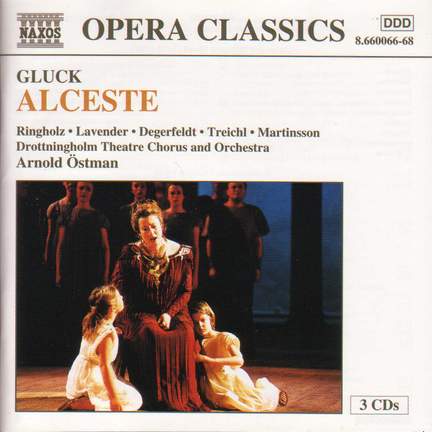
Almost all critics of Gluck's two versions of Alceste – the Italian original, first given in Vienna in 1767, and the French revision or recomposition given in Paris in 1776 – regard the latter...
Special offer. Gluck: Alceste
Jonas Degerfeldt, tenor, Justin Lavender, Lars Martinsson, baritone, Teresa Ringholz, Miriam Treichl, soprano
Drottningholm Theatre Orchestra, Drottningholm Theatre Chorus, Arnold Ostman
Purchase product
Almost all critics of Gluck's two versions of Alceste – the Italian original, first given in Vienna in 1767, and the French revision or recomposition given in Paris in 1776 – regard the latter...
About
Contents and tracklist
- Teresa Ringholz (soprano), Justin Lavender (tenor), Jonas Degerfeldt (tenor), Miriam Treichl (soprano), Lars Martinsson (baritone), Adam Giertz (treble), Emelie Clausen (treble), Mattias Nilsson (baritone), Johan Lilja (bass)
- Drottningholm Theatre Chorus, Drottningholm Theatre
- Arnold Östman
Awards and reviews
 2010
2010
Almost all critics of Gluck's two versions of Alceste – the Italian original, first given in Vienna in 1767, and the French revision or recomposition given in Paris in 1776 – regard the latter as superior: musically richer, more flexible, dramatically more persuasive, deeper in its treatment of the emotions and the humanity of the two central characters. But this performance of the Italian version treats the 1767 text on its own terms. Like the original Orfeo, the original Alceste is an opera pared down, in accordance with Gluck's and his librettist Calzabigi's reform principles, to deal with just a single issue: it's concerned exclusively with Alceste's sacrifice of her life to save that of her husband, Admeto, King of Thessaly, and the emotions that each of them and those around them feel. The performance is deftly paced and transparent in its textures.
There's no portentousness about Östman's direction, and the Drottningholm orchestra ensures that the detail of accompanying textures is clearly heard, playing gently and lightly in the dances.
Teresa Ringholz has a voice of modest dimensions, which she uses in a natural way, with little vibrato, firm, surely tuned, clear and well focused. She catches Alceste's increasingly passionate determination, at the close of Act 1, as her resolution to die to save her husband hardens, with its magnificent climax in 'Ombre, larve'. Her controlled manner – there's no outburst of grief when she bids her children farewell at the end of the act, for example – catches well the stylised nature of Gluck's expression.
Justin Lavender, as Admeto, is slightly less successful.
He has a generous tenor – fuller and weightier than that of the other tenor, Jonas Degerfelt, who sings gracefully and also with vitality – and he brings to the music a good deal of passion that occasionally threatens to go beyond the scale of the performance as a whole.
The smaller roles are very adequately done.
This recording conveys effectively the intensity and the integrity of Gluck's vision.