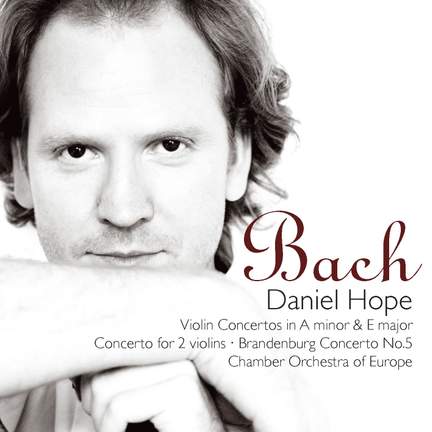
Daniel Hope plays Bach Violin Concertos
Daniel Hope (violin), with Marieke Blankestjin (violin)
Chamber Orchestra of Europe
Awards:
-
Gramophone Magazine, Awards Issue 2006, Editor's Choice

The sharply defined articulation of Daniel Hope, together with a phraseology closely allied to the dance, points up some of the differences between new and older schools of thought very well.
Daniel Hope plays Bach Violin Concertos
Daniel Hope (violin), with Marieke Blankestjin (violin)
Chamber Orchestra of Europe
Purchase product
Awards:
-
Gramophone Magazine, Awards Issue 2006, Editor's Choice
The sharply defined articulation of Daniel Hope, together with a phraseology closely allied to the dance, points up some of the differences between new and older schools of thought very well.
About
Contents and tracklist
- Kristian Bezuidenhout (harpsichord), Marieke Blankestijn (violin), Daniel Hope (violin)
- Chamber Orchestra of Europe
- Daniel Hope
- Javier Martín (flute), Kristian Bezuidenhout (harpsichord), Daniel Hope (violin)
- Chamber Orchestra of Europe
- Daniel Hope
Awards and reviews
-
Gramophone MagazineAwards Issue 2006Editor's Choice
 September 2006
The sharply defined articulation of Daniel Hope, together with a phraseology closely allied to the dance, points up some of the differences between new and older schools of thought very well.
 2010
2010
First impressions suggest a high-energy, tightly accented approach, 'period'-schooled while retaining an element of modern-instrument intensity, mostly in the slow movements. Daniel Hope sees to it that the bass-line is firm and prominent, which tends to underline the sense of urgency. The Double Concerto's Largo focuses two well-matched players responding to, rather than mirroring, each other, invariably with one using more vibrato than the other. Outer movements are fast and buoyant (the A minor's gigueallegro really whizzes along) and in the E major, Hope whirls into the first movement's second idea like a dervish possessed. Embellishment is legion, both along the solo line and in the discreetly balanced but lavishly stated continuo. The results approximate, more than usual with this music, dance models of the day, yet Hope always allows the slower music to breathe.
Plenty of air around the notes in the Fifth Brandenburg Concerto, too. Again the spirit of the dance is all-pervasive, but come the solo harpsichord cadenza, although Kristian Bezuidenhout plays brilliantly, the intrusive bending of tempo isn't entirely convincing. This sort of approach has become fairly popular: Rinaldo Alessandrini's set of Brandenburgs for Naïve is similarly individualistic. In most other respects this is a refreshing, often enlightening programme, very well recorded.
 Awards 2006
…a high-energy, tightly accent approach, "period" -schooled while retaining an element of modern-instrument intensity, mostly in the slow movements. The Double Concerto's Largo focuses two well matched players responding to, rather than mirroring, each other...