Leighton: Chamber Music
Lorraine McAslan (violin), Andrew Fuller (cello), Michael Dussek (piano)
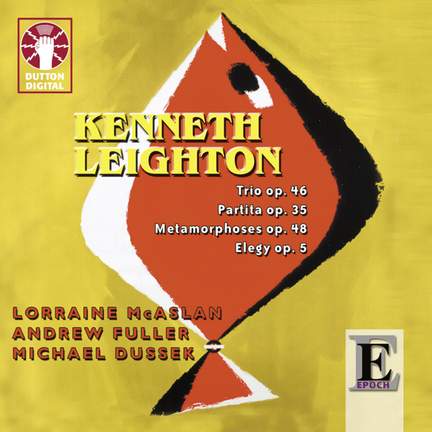
Although a fair amount of his music for voices has been recorded, Kenneth Leighton's orchestral and instrumental music is seriously under-represented in the catalogue. This most impressive disc...
Leighton: Chamber Music
Lorraine McAslan (violin), Andrew Fuller (cello), Michael Dussek (piano)
Purchase product
Although a fair amount of his music for voices has been recorded, Kenneth Leighton's orchestral and instrumental music is seriously under-represented in the catalogue. This most impressive disc...
About
Contents and tracklist
- Lorraine McAslan, Andrew Fuller, Michael Dussek
- Andrew Fuller, Michael Dussek
- Lorraine McAslan, Michael Dussek
- Andrew Fuller, Michael Dussek
Awards and reviews
 2010
2010
Although a fair amount of his music for voices has been recorded, Kenneth Leighton's orchestral and instrumental music is seriously under-represented in the catalogue. This most impressive disc gives a good idea of what we're missing: superbly crafted music of at times overwhelming intensity.
The craft and the intensity are inseparable: there's as little here of mere technical cleverness as there is of self-indulgent emotional display; the emotion both needs and is concentrated by tight control.
The Piano Trio is a characteristic example, its first movement building from close working of a broad, sweeping theme and a more subdued and shadowy one to a bitter eloquence slightly reminiscent of Shostakovich before a shadowy, drained conclusion. Calm is eventually achieved, but not serenity. The Partita has similar energy but a less fraught quality; there's even a sort of bony wit, again recalling Shostakovich, to some of the variations of the finale.
Metamorphoses, although ostensibly a single 21-minute movement, could be read as a monothematic sonata, with a quite violent scherzo and a slow finale, by turns poignant and ghostly. The very early Elegy reveals some of Leighton's English roots: descendants of its sustained lyrical theme can be heard in the later pieces, but there are some harmonic shifts that John Ireland would have approved.
The programme, in short, is an ideal introduction to this important but still underrated composer.
He's not underrated by these artists, however, who play with passionate conviction and splendid risk-taking attack; they're admirably recorded.