Special offer. Rautavaara: String Quintet 'Unknown Heavens' (1997), etc.
Jean Sibelius Quartet
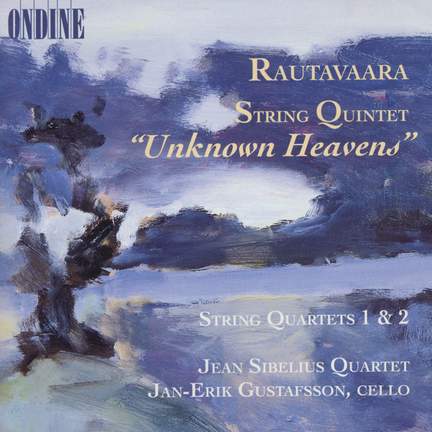
Here we encounter not one Rautavaara, but three: the fledgling student captivated by folklore; the dodecaphonic zealot stretching the expressive potential of 'the system'; and the triumphant...
Special offer. Rautavaara: String Quintet 'Unknown Heavens' (1997), etc.
Jean Sibelius Quartet
Purchase product
Here we encounter not one Rautavaara, but three: the fledgling student captivated by folklore; the dodecaphonic zealot stretching the expressive potential of 'the system'; and the triumphant...
About
Contents and tracklist
- Jan-Erik Gustafsson
- Jean Sibelius Quartet
- Jean Sibelius Quartet
- Jean Sibelius Quartet
Awards and reviews
 2010
2010
Here we encounter not one Rautavaara, but three: the fledgling student captivated by folklore; the dodecaphonic zealot stretching the expressive potential of 'the system'; and the triumphant melodist basking in his own unique brand of harmonic complexity. The stylistic leap from the Second Quartet to the Quintet, or Unknown Heavens is more a matter of tone than temperament. All three works are ceaselessly active, the First (1952) being perhaps the leanest, and the last (1997) the richest in texture.
Unknown Heavens takes its name from an earlier work for male chorus, which Rautavaara quotes, initially in the second bar of the first movement ('when the second violin answers the question opposed by the first,' as Rautavaara writes), many times thereafter, and then significantly revised at the start of the fourth movement. The third begins as a cello duet, sure justification of why five players are employed where the Kuhmo Music Festival originally commissioned a piece for four. 'The work seemed to acquire a will of its own,' writes Rautavaara. The equally wellperformed string quartets are stylistically rather more challenging. The First Quartet plays for just over 11 minutes and inhabits a mildly rustic world roughly akin to Kodály. Best here is the Andante's haunting coda, whereas the 1958 Second Quartet is at its most inventive for the faster second and fourth movements. The current Rautavaara is more relaxed, more contemplative, wiser and softer-grained than his former self. He seems happier reflecting nature than organising abstract patterns: you sense that the Quintet is authentically self-expressive, whereas the quartets speak interestingly about nothing in particular. The recordings are full-bodied and well balanced.