Special offer. R Strauss: A Cappella Choral Works
Tina Kiberg (soprano), Randi Stene (contralto), Gert Henning Jensen (tenor), Ulrik Cold (bass)
Copenhagen Boys' Choir, Danish National Radio Chamber Choir, Danish National Choir/DR, Stefan Parkman
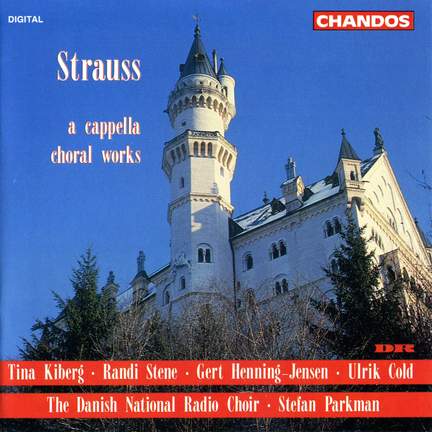
Under Stefan Parkman the Danish National Radio Choir has established a reputation second to none. Parkman handles his singers as if they were a fully fledged symphony orchestra; which isn't...
Special offer. R Strauss: A Cappella Choral Works
Tina Kiberg (soprano), Randi Stene (contralto), Gert Henning Jensen (tenor), Ulrik Cold (bass)
Copenhagen Boys' Choir, Danish National Radio Chamber Choir, Danish National Choir/DR, Stefan Parkman
Purchase product
Under Stefan Parkman the Danish National Radio Choir has established a reputation second to none. Parkman handles his singers as if they were a fully fledged symphony orchestra; which isn't...
About
Contents and tracklist
- Stefan Parkman, Danish National Symphony Choir
Work length17:53
This work is only available as an album download.
- Stefan Parkman, Danish National Symphony Choir, Tina Kiberg, Randi Stene, Gert Henning Jensen, Ulrik Cold, Susse Lillesøe, Hjørdis Jakobsen
- Stefan Parkman, Danish National Symphony Choir, Danish National Radio Chamber Choir
- Stefan Parkman, Danish National Symphony Choir, Copenhagen Boys' Choir, Marianne Lund, Christian Lisdorf
Awards and reviews
 2010
2010
Under Stefan Parkman the Danish National Radio Choir has established a reputation second to none. Parkman handles his singers as if they were a fully fledged symphony orchestra; which isn't at all inappropriate in this programme by the supreme master of orchestral colour.
From the heart of the 16 chorus parts of the Deutsche Motette a further seven are projected by solo voices emerging imperceptibly from the midst of a dense, luxuriant texture. The depth of colour and range of emotions are every bit as extensive in these works as in the great orchestral tone-poems; indeed few orchestral tonepoems evoke dusk and sunset so vividly as 'Der Abend', the first of the 1897 Zwei Gesänge.
There's a wonderfully luminous soundscape here; a combination of superb compositional skill, sensitive musical direction, superlative choral singing and a warm, full-bodied recording.