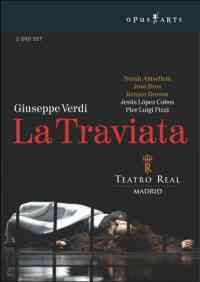
Special offer. Verdi: La Traviata
Stage Director - Pier Luigi Pizzi
Norah Amsellem, José Bros, Renato Bruson, Itxaro Mentxaka, Maria Espada, Emilio Sánchez, David Rubiera & Marco Moncloa
Chorus and Orchestra of the Teatro Real, Madrid, Jesús López Cobos
Awards:
-
Gramophone Magazine, September 2006, DVD of the Month

Pier Luigi Pizzi's updating of Traviata to occupied Paris, first seen in 2003 in Madrid, might seem gratuitous, but because of his skill as designer and his experience directing singers, the...
Special offer. Verdi: La Traviata
Stage Director - Pier Luigi Pizzi
Norah Amsellem, José Bros, Renato Bruson, Itxaro Mentxaka, Maria Espada, Emilio Sánchez, David Rubiera & Marco Moncloa
Chorus and Orchestra of the Teatro Real, Madrid, Jesús López Cobos
Purchase product
Awards:
-
Gramophone Magazine, September 2006, DVD of the Month
Pier Luigi Pizzi's updating of Traviata to occupied Paris, first seen in 2003 in Madrid, might seem gratuitous, but because of his skill as designer and his experience directing singers, the...
About
Contents and tracklist
- Illustrated Synopsis & Cast Gallery
- Norah Amsellem, José Bros, Renato Bruson, Itxaro Mentxaka, Maria Espada, Emilio Sánchez, David Rubiera & Marco Moncloa
- Chorus and Orchestra of the Teatro Real, Madrid
- Jesús López Cobos
Spotlight on this release
-
An error occurred.
Try watching this video on www.youtube.com, or enable JavaScript if it is disabled in your browser.
Awards and reviews
-
Gramophone MagazineSeptember 2006DVD of the Month
 2010
2010
Pier Luigi Pizzi's updating of Traviata to occupied Paris, first seen in 2003 in Madrid, might seem gratuitous, but because of his skill as designer and his experience directing singers, the new milieu hardly ever interferes, after the opening scene, with the central tragedy of Violetta's plight. That owes much to the freshness and immediacy of the portrayal by Norah Amsellem. From Violetta's first fevered entry to her agonising death she is totally absorbed in the role, acting and singing with the most eloquent feeling.
In the first scene we see her entering her soirée from her bedroom, the stage split in two – a slightly questionable idea – and she becomes infatuated with Alfredo in their Act 1 duet while on her lavish bed. It sounds gimmicky but as played by Amsellem and the sympathetic and stylishly sung Alfredo of José Bros it is totally convincing. The act ends with an all-consuming account of 'Ah! fors e lui', both verses, shaped in long lines and phrased with unerring conviction so that one forgives harshness when she presses on her higher notes.
Act 2 scene 1 is set in the drawing-room of a 1930s-style country villa. Here the central encounter of Violetta and Germont père is the emotional centre of the work, as it should be, with Amsellem and Renato Bruson acting and reacting to each other with rewarding rapport.
Bruson, at 69, sings with all the experience of his years and few signs of wear, and follows it with a masterly account of 'Di provenza'. In the second scene the whole company excels itself and the heroine is infinitely touching in 'Alfredo, Alfredo'.
In a stark, simple set for Act 3, this Violetta conveys her sorrow and terrified thoughts with inward passion. 'Addio del passato', again two verses, is notable for the length of line and exquisite phrasing Amsellem provides. She and Bros sing a near-ideal 'Parigi, o cara' before Violetta dies, a desperately tragic figure. Amsellem's slim figure and expressive face are notable assets in achieving her intelligent reading.
López-Cobos conducts an interpretation notable for yielding support of his singers combined with dramatic dash, and the Madrid orchestra play as though their lives depended on the results. No wonder this staging has received so much praise in Spain. Its preservation on DVD is welcome.
 September 2006
Pier Luigi Pizzi's updating of Traviata to occupied Paris… might seem gratuitous, but because of his skill as designer and his experience in directing singers, the new milieu hardly ever interferes… with the central tragedy of Violetta's plight. That owes much to the freshness and immediacy of Norah Amsellem. From Violetta's first fevered entry to her agonising death, she is totally absorbed, acting and singing with the most eloquent feeling. López-Cobos conducts an interpretation notable for yielding support of his singers combined with dramatic dash, and the Madrid orchestra play as though their lives depended on the results.