Stephan: Die ersten Menschen
Siegmund Nimsgern (bass), Gabriele Maria Ronge (soprano), Florian Cerny (baritone) & Hans Aschenbach (tenor)
Rundfunk-Sinfonieorchester Berlin, Karl Anton Rickenbacher
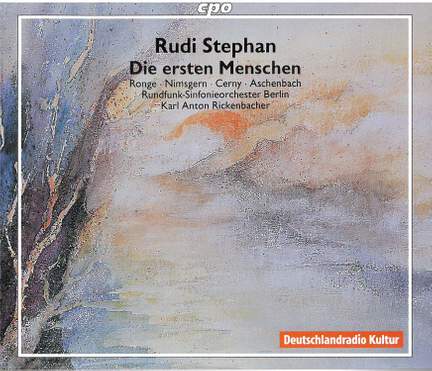
Die ersten Menschen ('The first humans'), the Bible story of Cain and Abel given an erotic, early-20th-century psychological spin by playwright Otto Borngräber, was Stephan's first and only...
Stephan: Die ersten Menschen
Siegmund Nimsgern (bass), Gabriele Maria Ronge (soprano), Florian Cerny (baritone) & Hans Aschenbach (tenor)
Rundfunk-Sinfonieorchester Berlin, Karl Anton Rickenbacher
Purchase product
Die ersten Menschen ('The first humans'), the Bible story of Cain and Abel given an erotic, early-20th-century psychological spin by playwright Otto Borngräber, was Stephan's first and only...
About
Contents and tracklist
- Siegmund Nimsgern, Gabriele Maria Ronge, Florian Cerny, Hans Aschenbach
- Berlin Radio Symphony Orchestra
- Karl Anton Rickenbacher
- Gabriele Maria Ronge, Florian Cerny, Hans Aschenbach, Siegmund Nimsgern
- Berlin Radio Symphony Orchestra
- Karl Anton Rickenbacher
Awards and reviews
 2010
2010
Die ersten Menschen ('The first humans'), the Bible story of Cain and Abel given an erotic, early-20th-century psychological spin by playwright Otto Borngräber, was Stephan's first and only completed opera. The musical language is most akin to that of Richard Strauss, yet, when you start making detailed comparisons with individual works, it's more often the case that the younger composer is anticipating or paralleling the progress of his famous contemporary. The quasi-recitative setting of dialogues recalls strongly Barak and his brothers in Die Frau ohneSchatten, while Chawa's (Eve's) big opening number in Act 2, 'Allmachtiger', feels like a first run for Helena's 'Zweite Brautnacht' more than a decade in the future. Occasionally, too, a certain folky tang or Oriental lushness (Stephan invoking the world just post-Garden of Eden) reminds us that Duke Bluebeard's Castle was on Bartók's desk at the same period.
The four-handed, two-act drama runs its course excitingly until Abel's murder. If Stephan sometimes is over-faithful to Borngräber's play in the sheer amount of soliloquising he gives his characters (especially Kajihn, his Cain), and is rather too fond of tremolando effects, it's a significant and obviously stageable achievement for a first go at the medium. This performance is blessed by fluent, stylish singing, especially from Gabriele Maria Ronge as the (literally) much put-upon Chawa/Eve, but lacks that extra degree of dramatic insight that an interpretation taken from the stage would have brought. Karl Anton Rickenbacher, an expert in rare Strauss, is careful to allow Stephan's often Pfitzner-like lyricism its say alongside more purple passages. The 1998 recording (Deutschland Radio) is clean and true.
So far, so good – but once again the wholly incompetent English translations used by CPO render booklet-note and libretto both risible and annoying to non-German readers.