Help
Skip to main content

Handel: Alexander Balus

Lynne Dawson (soprano), Michael George (bass), Catherine Denley (contralto), Charles Daniels (tenor), Claron McFadden (soprano)

The King's Consort, Choir of The King's Consort, New College Choir, Oxford, Robert King
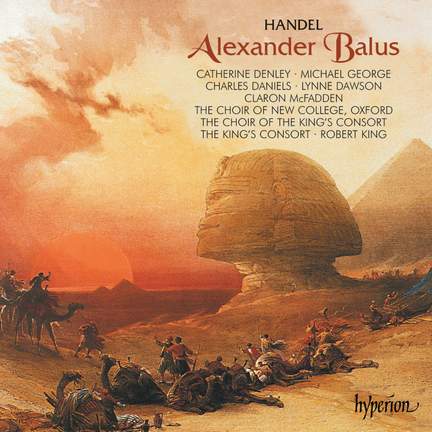
Handel: Alexander Balus
Alexander Balus has never been one of Handel's more popular oratorios. That's mainly because its plot is by modern standards lacking in drama and motivation, and accordingly doesn't call forth...

Handel: Alexander Balus

Lynne Dawson (soprano), Michael George (bass), Catherine Denley (contralto), Charles Daniels (tenor), Claron McFadden (soprano)

The King's Consort, Choir of The King's Consort, New College Choir, Oxford, Robert King

Purchase product

2 CDs

$24.50

In stock - only 32 left: usually despatched within 1 working day

Download

From$14.25

Download

Audio formats guide

44.1 kHz, 16 bit, FLAC/ALAC/WAV

$21.25

320 kbps, MP3

$14.25

This release includes a digital booklet

Stream now lossless, 44.1 kHz, 16 bit
Alexander Balus has never been one of Handel's more popular oratorios. That's mainly because its plot is by modern standards lacking in drama and motivation, and accordingly doesn't call forth...

About

Alexander Balus brings to completion The King's Consort's series of Handel's four 'military' oratorios (the other three being Judas Maccabaeus, The Occasional Oratorio, and Joshua). The story is a somewhat embellished retelling of chapters 10 and 11 from the first book of the Apocryphal Maccabees and involves complicated intrigues between the Jews, Syrians and Egyptians in the second century BC. To cut a long story short, Alexander Balus, King of Syria, is eventually defeated in battle by Ptolomee of Egypt and then killed by an Arab; but Ptolomee himself dies just three days later allowing Jonathan, the Chief of the Jews, to remind us of the fate of those who do not believe in the One God. Musically, Handel is at his very best in this piece. Much of the composition occurred simultaneously with that for Joshua and there is, typically, a small amount of material recycled from earlier works. The Third Act, where Cleopatra is not only told (maliciously) by her father that her beloved Alexander has been faithless, but is also then informed of his death, sees some extraordinary aria-writing, at times reminiscent of 'Dido's Lament'.

Contents and tracklist

Act 1 Ouverture. [Grave] – Allegro
Track length2:51
Act 1 Scene 1 No 01. Chorus. Flush'd with conquest, fir'd by Mithra (Asiates)
Track length3:11
Act 1 Scene 1 No 02. Recitative. Thus far, ye glorious partners of the war (Alexander / Jonathan)
Track length1:28
Act 1 Scene 1 No 03. Air. Great Author of this harmony (Jonathan)
Track length3:17
Act 1 Scene 1 No 04. Flourish of trumpets
Track length0:11
Act 1 Scene 1 No 05. Recitative. And thus let happy Egypt's king (Ptolomee)
Track length0:24
Act 1 Scene 1 No 06. Air. Thrice happy the monarch, whom nations content (Ptolomee)
Track length3:43
Act 1 Scene 1 No 07. Recitative. Congratulation to our father's friend (Cleopatra)
Track length0:25
Act 1 Scene 1 No 08. Air. Hark! hark! he strikes the golden lyre (Cleopatra)
Track length5:58
Act 1 Scene 1 No 09. Recitative. Be it my chief ambition there to rise (Alexander)
Track length0:14
Act 1 Scene 1 No 10. Air. Fair virtue shall charm me (Alexander)
Track length2:24
Act 1 Scene 1 No 11. Chorus. Ye happy nations round (Asiates)
Track length3:02
Act 1 Scene 2 No 1. Recitative. My Jonathan (Alexander)
Track length0:35
Act 1 Scene 2 No 2. Air. Oh, what resistless charms are giv'n (Alexander)
Track length4:13
Act 1 Scene 3 No 1. Air. Subtle love, with fancy viewing (Cleopatra)
Track length4:55
Act 1 Scene 3 No 2. Recitative. Aspasia, I know not what to call (Cleopatra)
Track length0:45
Act 1 Scene 3 No 3. Air. How happy should we mortals prove (Cleopatra)
Track length2:26
Act 1 Scene 3 No 4. Recitative. Check not the pleasing accents of thy tongue (Aspasia)
Track length0:24
Act 1 Scene 3 No 5. Air. So shall the sweet attractive smile (Aspasia)
Track length2:40
Act 1 Scene 3 No 6. Recitative. How blissful state! (Cleopatra / Aspasia)
Track length0:26
Act 1 Scene 3 No 7. Duet. O what pleasures, past expressing (Cleopatra / Aspasia)
Track length3:00
Act 1 Scene 4 No 1. Recitative. Why hangs this heavy gloom upon the brow (Jonathan / Alexander)
Track length1:00
Act 1 Scene 4 No 2. Air. Heroes may boast their mighty deed (Alexander)
Track length4:52
Act 1 Scene 5 No 1. Recitative. Ye sons of Judah, with high festival (Jonathan)
Track length0:31
Act 1 Scene 5 No 2. Air with chorus. Great God, from whom all blessings spring (Jonathan / Israelites)
Track length4:38
Act 2 Scene 1 No 1. Air. Kind hope, thou universal friend (Alexander)
Track length6:04
Act 2 Scene 1 No 2. Recitative. Long, long and happy live the king! (Jonathan / Alexander)
Track length0:40
Act 2 Scene 1 No 3. Air. O Mithra, with thy brightest beams (Alexander)
Track length4:17
Act 2 Scene 1 No 4. Recitative. Stay, my dread sovereign (Sycophant courtier / Alexander / Jonathan)
Track length1:39
Act 2 Scene 1 No 5. Air. Mighty love now calls to arm (Alexander)
Track length2:36
Act 2 Scene 1 No 6. Air. Hateful man! thy sland'rous tongue (Jonathan)
Track length4:21
Act 2 Scene 1 No 7. Chorus. O calumny, on virtue waiting (Israelites)
Track length4:21
Act 2 Scene 2 No 1. Recitative. Ah! whence these dire forebodings of the mind? (Cleopatra)
Track length0:39
Act 2 Scene 2 No 2. Air. Tossed from thought to thought I rove (Cleopatra)
Track length6:29
Act 2 Scene 2 No 3. Recitative. Give to the winds, fair princess, these vain doubts (Aspasia)
Track length0:22
Act 2 Scene 2 No 4. Air. Love, glory, ambition, whate'er can inspire (Aspasia)
Track length2:50
Act 2 Scene 3 No 1. Recitative. Thus far my wishes thrive (Ptolomee)
Track length0:54
Act 2 Scene 3 No 2. Air. Virtue, thou ideal name (Ptolomee)
Track length3:43
Act 2 Scene 4 No 1. Accompagnato. Ye happy people, with loud accents speak (Jonathan)
Track length0:37
Act 2 Scene 4 No 2. Soli with chorus. Triumph Hymen in the pair
Track length2:40
Act 2 Scene 4 No 3. Recitative. Glad time, at length, hath reach'd the happy point (Alexander / Cleopatra)
Track length0:48
Act 2 Scene 4 No 4. Duet. Hail wedded love, mysterious law! (Alexander / Cleopatra)
Track length3:39
Act 2 Scene 4 No 5. Chorus. Hymen, fair Urania's son (Asiates)
Track length2:38
Act 3 Introduction. Sinfonia
Track length1:15
Act 3 Scene 1 No 1. Recitative. 'Tis true, instinctive nature seldom points (Cleopatra)
Track length0:29
Act 3 Scene 1 No 2. Air with chorus. Here amid the shady woods (Cleopatra / Ruffians)
Track length4:17
Act 3 Scene 2 No 1. Recitative. Ah! was it not my Cleopatra's voice? (Alexander)
Track length0:41
Act 3 Scene 2 No 2. Air. Pow'rful guardians of all nature (Alexander)
Track length2:53
Act 3 Scene 2 No 3. Recitative. Treach'ry, O king, unheard of treachery (Jonathan / Alexander / Aspasia)
Track length1:23
Act 3 Scene 2 No 4. Air. Fury, with red sparkling eyes (Alexander)
Track length6:24
Act 3 Scene 2 No 5. Recitative. Gods! can there be a more afflicting sight (Aspasia)
Track length0:24
Act 3 Scene 2 No 6. Air. Strange reverse of human fate (Aspasia)
Track length2:50
Act 3 Scene 2 No 7. Recitative. May he return with laurel'd victory (Jonathan)
Track length0:26
Act 3 Scene 2 No 8. Air. To God who made the radiant sun (Jonathan)
Track length3:13
Act 3 Scene 2 No 9. Chorus. Sun, moon, and stars, and all ye Host of Heav'n (Israelites)
Track length2:51
Act 3 Scene 3 No 1. Recitative. Yes he was false, my daughter, false to you (Jonathan / Cleopatra)
Track length1:19
Act 3 Scene 3 No 2. Accompagnato. Ungrateful child, by ev'ry sacred pow'r (Ptolomee)
Track length0:26
Act 3 Scene 3 No 3. Air. O sword, and thou, all-daring hand (Ptolomee)
Track length2:50
Act 3 Scene 4 No 1. Accompagnato. Shall Cleopatra ever smile again? (Cleopatra)
Track length0:43
Act 3 Scene 4 No 2. Recitative. Ungrateful tidings to the royal ear (Messenger)
Track length1:23
Act 3 Scene 4 No 3. Air. O take me from this hateful light (Cleopatra)
Track length5:17
Act 3 Scene 4 No 4. Recitative. Forgive, O queen, the messenger of ill! (Second messenger / Cleopatra)
Track length1:23
Act 3 Scene 4 No 5. Accompagnato. Calm thou my soul (Cleopatra)
Track length0:47
Act 3 Scene 4 No 6. Air. Convey me to some peaceful shore (Cleopatra)
Track length2:41
Act 3 Scene 5 No 1. Recitative. Mysterious are thy ways, O Providence! (Jonathan)
Track length1:20
Act 3 Scene 5 No 2. Chorus with solo. Ye servants of th' eternal King (Jonathan / Israelites)
Track length3:20

Awards and reviews

2010

Alexander Balus has never been one of Handel's more popular oratorios. That's mainly because its plot is by modern standards lacking in drama and motivation, and accordingly doesn't call forth the vein of his music that nowadays has the strongest appeal. It's essentially a sentimental drama, in which the interest centres on the characters' emotional reactions to their situations, amatory, political and religious, and these are rather static in the first two acts but much more powerful in the more eventful third with the deaths of both Alexander and Ptolomee.
Here we have a very capable, idiomatic, sensibly cast performance under Robert King. The choruses are especially accomplished. The New College Choir, supported by men from The King's Consort Choir, is confident, brighttoned and vigorous, clean in line and well balanced.
Lynne Dawson sings beautifully in her firm and resonant soprano and her usual poised and unaffected style. Her singing of the lamenting music in the final act is particularly moving.
Cleopatra has a couple of duets, one with some attractive interplay with the secondary character Aspasia, sung with much assurance by Claron McFadden. As Alexander, Catherine Denley sings with much confidence and directness in music that isn't all of special individuality.
Jonathan is sung fluentlyand warmly, but very plainly, by Charles Daniels. Lastly there's Michael George, who's ideally suited to the villainous Ptolomee, with his forceful (but always musical) manner and the touch of blackness in his tone. The orchestral playing is accomplished, and often rather carefully shaped. The recitative moves at a steady but natural pace; ornamentation is generally modest. All Handelians will want to acquire this set, and others should not be put off by the indifferent press Alexander Balus has received from time to time.

We may be grateful that yet another glory has been restored by Robert King and his accomplished forces

View download progress