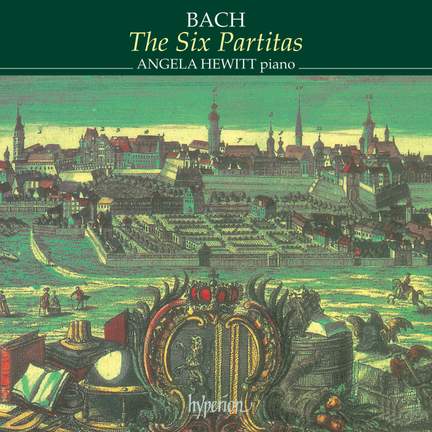
J.S. Bach: The Six Partitas
Angela Hewitt (piano)
Awards:
-
Building a Library, December 2000, Piano Choice

Everything has been deeply considered. Everything works. Hewitt makes a beautiful, limpid sound; her ornaments are exquisitely precise as well as sounding natural; she uses the subtle shadings...
J.S. Bach: The Six Partitas
Angela Hewitt (piano)
Purchase product
Awards:
-
Building a Library, December 2000, Piano Choice
Everything has been deeply considered. Everything works. Hewitt makes a beautiful, limpid sound; her ornaments are exquisitely precise as well as sounding natural; she uses the subtle shadings...
About
Astonishingly, the Six Partitas for Clavier were the first works Bach published – after more than twenty years of composing. 'Opus 1' (as he called it) was 'offered to music lovers in order to refresh their spirits' and the works scored an immediate hit, becoming core repertoire for keyboard players both professional and amateur. 'Partita' is simply another name for a suite of dance movements, and each of these collections combines grace, agility and sprightliness with a nobleness of spirit which makes them not only accessible and attractive, but also worthy in every way of their position in the Clavierübung – Bach's own summation of his compositional skills.
Contents and tracklist
Awards and reviews
Classic CD
Everything has been deeply considered. Everything works. Hewitt makes a beautiful, limpid sound; her ornaments are exquisitely precise as well as sounding natural; she uses the subtle shadings and variations of volume possible on the piano without swamping the music. Technically the paying is faultless ... superbly poised, light and joyous. Indeed, that would sum up the entire set
 2010
2010
If Bach is to be played on the piano, this is the kind of way to do it. Inherent in all Hewitt's playing is a rhythmic vitality, always under control, that sweeps you along with its momentum, subtly varied articulation, dynamics that follow the natural rise or fall of phrases without exaggerations, an appreciation of Bach's harmonic tensions, an ability to differentiate between the strength of contrapuntal lines, and an unfailing clarity of texture.
This is a sane and sensible interpretation, deeply musicianly and devoid of eccentricity.
Her attitude, rather like Toscanini's, is to accept the text com' è scritto and then to make legitimate adjustments, so we get double-dotting and assimilation of rhythms. Technically she's immaculate, with the cleanest possible ornaments.
In the great E minor Sarabande Hewitt is justifiably emotional, without becoming soggy: only in the first half of the A minor Allemande is there a hint of coyness. No, the whole disc gives unalloyed pleasure.