Scriabin - Complete Sonatas
Marc-André Hamelin (piano)
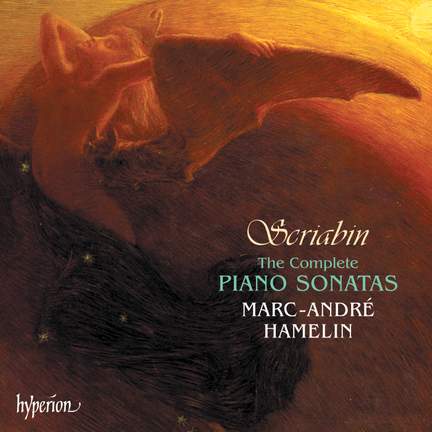
Scriabin was an ambitious composer. A romantic alchemist, he saw his music as a transmuting agent. Through its influence pain would become happiness and hate become love, culminating in a phoenix-like...
Scriabin - Complete Sonatas
Marc-André Hamelin (piano)
Purchase product
Scriabin was an ambitious composer. A romantic alchemist, he saw his music as a transmuting agent. Through its influence pain would become happiness and hate become love, culminating in a phoenix-like...
About
Both as composer and virtuoso pianist, Scriabin was heir to the Classical and Romantic sonata tradition, but the transformation of this musical language in his own works was to be crucial for the survival of the sonata principle into the twentieth century. This set includes all ten of the 'mature' Sonatas, the Fantaisie, Op 28, and the youthful Sonate-fantaisie. This last, published only after the composer's death, shows an astonishingly sure hand developing in the fourteen-year-old.
Contents and tracklist
Spotlight on this release
-
Marc-André Hamelin on Found Objects/Sound Objects
30th Dec 2025
The Canadian pianist discusses his recent album of music by Frank Zappa, John Cage, Yehudi Wyner and others, his own approach to writing for the piano, and the composer who will be the focus of a upcoming 'long-range project'...

Awards and reviews
 2010
2010
Scriabin was an ambitious composer. A romantic alchemist, he saw his music as a transmuting agent. Through its influence pain would become happiness and hate become love, culminating in a phoenix-like rebirth of the universe.
With Shakespearian agility he would change the world's dross into 'something rich and strange'. Not surprisingly, given Scriabin's early prowess as a pianist, the 10 sonatas resonate with exoticism, ranging through the First Sonata's cries of despair, to the Second Sonata's Baltic Sea inspiration, the Third Sonata's 'states of being', the 'flight to a distant star' (No 4) and 'the emergence of mysterious forces' (No 5). Nos-7 and 9 are White and Black Mass Sonatas respectively, and the final sonatas blaze with trills symbolising an extra-terrestrial joy and incandescence.
Such music makes ferocious demands on the pianist's physical stamina and imaginative resource. However, Marc-André Hamelin takes everything in his stride. Blessed with rapier reflexes he nonchalantly resolves even the most outlandish difficulties. He launches the First Sonata's opening outcry like some gleaming trajectory and, throughout, his whistle-stop virtuosity is seemingly infallible.
You might, however, miss a greater sense of the music's Slavonic intensity, its colour and character; a finer awareness, for example, of the delirious poetry at the heart of the Second Sonata's whirling finale. Hamelin's sonority is most elegantly and precisely gauged but time and again his fluency (admittedly breathtaking) erases too much of the work's originality and regenerative force. However, he shows a greater sense of freedom in the Fifth Sonata, and in the opalescent fantasy of the later sonatas, he responds with more evocative skill to subjective terms, as well as to moments where Scriabin's brooding introspection is lit by sudden flashes of summer lightning.
The recordings are a little tight and airless in the bass and middle register, but the set does includes a superb essay on Scriabin.