Puccini: Edgar
Plácido Domingo (Edgar), Adriana Damato (Fidelia), Marianne Cornetti (Tigrana), Juan Pons (Frank), Rafael Siwek (Gualtiero)
Coro e Orchestra dell'accademia Nazionale di Santa Cecilia, Alberto Veronesi
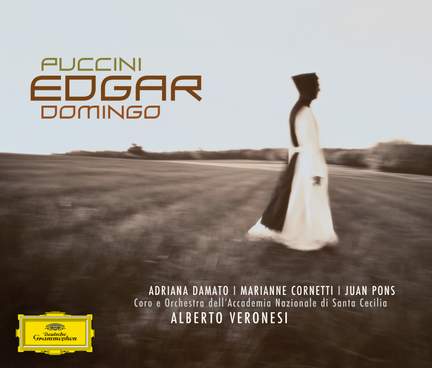
Edgar, Puccini's second opera, composed in 1888 and first given the following year at La Scala, has never really caught on. The title-role is the only Puccini tenor lead role that Plácido Domingo...
Puccini: Edgar
Plácido Domingo (Edgar), Adriana Damato (Fidelia), Marianne Cornetti (Tigrana), Juan Pons (Frank), Rafael Siwek (Gualtiero)
Coro e Orchestra dell'accademia Nazionale di Santa Cecilia, Alberto Veronesi
Purchase product
Edgar, Puccini's second opera, composed in 1888 and first given the following year at La Scala, has never really caught on. The title-role is the only Puccini tenor lead role that Plácido Domingo...
About
Contents and tracklist
- Roberto Gabbiani, Adriana Damato (soprano), Plácido Domingo (tenor), Marianne Cornetti (mezzo-soprano), Juan Pons (baritone), Rafal Siwek (bass), Pablo Assante
- Orchestra dell'Accademia Nazionale di Santa Cecilia, Coro dell'Accademia Nazionale Di Santa Cecilia
- Alberto Veronesi
- Recorded: 2005-06-09
- Recording Venue: Auditorium Parco della Musica, Sala Santa Cecilia, Roma
Spotlight on this release
-
Giacomo Puccini
11th Jul 2014
James has a lovely time revelling in the wealth of magnificent Puccini recordings on offer, and selects some of his personal favourites.

Awards and reviews
 2010
2010
Edgar, Puccini's second opera, composed in 1888 and first given the following year at La Scala, has never really caught on. The title-role is the only Puccini tenor lead role that Plácido Domingo has never sung until now. In his 65th year (the recording was made in 2005, just after his Covent Garden Siegmund) it is a tribute to his tenacity and vigour that he should have learned it, and gone on to give such a convincing performance.
There is no hint of strain, and throughout an arduous three acts he uses his voice with all his accustomed commitment and fervour.
The music is full of pre-echoes of Puccini's later works and the orchestra is constantly employed in a remarkably confident and innovative way for a beginner in his late twenties. What no one can do is to rescue the opera from its libretto. Fernando Fontana based it on a story by Alfred de Musset, in which the hero burns down his own house to show his contempt for his fellow countrymen. He makes off with the hysterical and sacrilegious gypsy Tigrana, but then grows tired of their illicit liaison and yearns for Fidelia, the girl next door back in the Tyrol.
After a victorious battle, he has his armour sent home, and in disguise as a monk, watches his own funeral. At the last moment, as he prepares to escape with Fidelia, the seductress Tigrana stabs her to death.
The finale of Act 1, in which Edgar defends Tigrana against the townspeople, builds up to a spectacular ensemble. The opening of Act 2, with a mournful woodwind solo which looks forward to the prelude to 'E luceven le stelle' in Tosca, has Edgar's big aria, 'L'orgia, chimera dall'occhio ardente'. There is a passionate duet, in which he rejects Tigrana. The final act, the most confusing dramatically, has a pair of beautiful arias for Fidelia.
Domingo is well partnered by Marianna Cornetti as Tigrana and Adriana Damato as Fidelia.
Juan Pons takes the rather ungrateful role of Frank, Fidelia's brother, and a rival for Tigrana's affections. The emotional turmoil in which Edgar finds himself is not unlike that of Don José in Carmen – a man torn between the lure of raw sex and the ideal of virtuous simplicity.
Edgar tries to take advantage of both, with tragic consequences.
Alberto Veronesi conducts an often exciting performance, the first studio-made set (the Sony and Naïve versions both derive from concerts).
Carlo Bergonzi and Renata Scotto for Sony and Carl Tanner and Julia Varady for Naïve provide stiff competition – not many people would find it necessary to own two recordings, let alone three, of this early work. Nevertheless, the new set is an easy recommendation.
Puccini retained an affection for the score and made several revisions of it, the final one as late as 1905. However, he called it 'warmed-up soup', adding cruelly but accurately that the subject was 'unbelievable trash'.
 June 2006
The title-role is the only Puccini tenor lead role that Plácido Domingo has never sung until now. There is no hint of strain, and throughout an arduous three acts he used his voice with all his accustomed commitment and fervour. Domingo is well partnered by Marianne Cornetti as Tigrana and Adriana Damato Fidelia. Alberto Veronesi conducts an often exciting performance...
 July 2014
This recording follows the revised, three-act version of the opera, and features Plácido Domingo in the title role, with Adriana Damato and Marianne Cornetti in the roles of Fidelia and Tigrana. Although the opera was not a success when first performed, and Puccini himself was rather scathing about it in later life, it does contain some fine music, and is worth investigating.