Special offer. Gossec: Le Triomphe de la République
Salomé Haller (soprano), Antonella Balducci (soprano), Guillemette Laurens (mezzo-soprano), Makato Sakurada (tenor), Claudio Danuser (baritone), Philippe Huttenlocher (bass) & Arnaud Marzorati (bass)
Coro della Radio Svizzera, Lugano, Coro Calicantus & I Barocchisti, Diego Fasolis
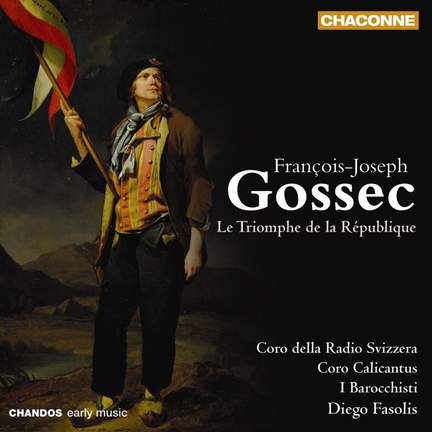
Diego Fasolis and his performers deliver this extraordinary score with no hint of embarrassment at its pervasive simplicity in a brightly-hued recording. Choral vocal lines are mostly firm,...
Special offer. Gossec: Le Triomphe de la République
Salomé Haller (soprano), Antonella Balducci (soprano), Guillemette Laurens (mezzo-soprano), Makato Sakurada (tenor), Claudio Danuser (baritone), Philippe Huttenlocher (bass) & Arnaud Marzorati (bass)
Coro della Radio Svizzera, Lugano, Coro Calicantus & I Barocchisti, Diego Fasolis
Purchase product
Diego Fasolis and his performers deliver this extraordinary score with no hint of embarrassment at its pervasive simplicity in a brightly-hued recording. Choral vocal lines are mostly firm,...
About
Contents and tracklist
- Diego Fasolis, I Barocchisti, Coro della Radio Svizzera, Arnaud Marzorati, Guillemette Laurens, Coro Calicantus, Mario Fontana, Claudio Danuser
- Diego Fasolis, I Barocchisti, Makato Sakurada, Salomé Haller, Coro della Radio Svizzera, Philippe Huttenlocher, Coro Calicantus, Mario Fontana
- Diego Fasolis, I Barocchisti, Guillemette Laurens, Coro della Radio Svizzera, Coro Calicantus, Mario Fontana
- Diego Fasolis, I Barocchisti, Philippe Huttenlocher, Salomé Haller, Arnaud Marzorati, Coro della Radio Svizzera, Coro Calicantus, Mario Fontana
- Diego Fasolis, I Barocchisti, Arnaud Marzorati, Claudio Danuser, Makato Sakurada, Guillemette Laurens, Coro della Radio Svizzera, Coro Calicantus, Mario Fontana
- Diego Fasolis, I Barocchisti, Antonella Balducci, Coro della Radio Svizzera, Claudio Danuser, Coro Calicantus, Guillemette Laurens, Mario Fontana
Awards and reviews
 May 2006
Diego Fasolis and his performers deliver this extraordinary score with no hint of embarrassment at its pervasive simplicity in a brightly-hued recording. Choral vocal lines are mostly firm, Gossec's richly upholstered orchestral lines are handsomely shaped and the soloists sing with bright-eyed conviction. Very much a period piece, but one worth dipping into.
 2010
2010
After the events of 1789, François-Joseph Gossec (1734-1829) became an ardent musical icon of the revolution: Le Triomphe de la République (1793) is a single-act lyric divertissement, written to glorify the victory of the Republic's army over anti-French troops led by the Duke of Brunswick at the battle of Valmy on September 20, 1792. In his informative essay, Carlo Piccardi explains that 'emerging from the houses of the aristocracy and the theatres into the wide-open public spaces, music was undergoing a radical change that was itself revolutionary'.
Diego Fasolis, the Swiss Radio Choir and the excellent I Barocchisti here provide a good account of Gossec's fervent piece of propaganda.
The militant overture has sharp attack, bold brass and booming drums. The choruses 'Dieu du peuple' and 'Malheur au despotisme' bring to mind the kind of French revolutionary songs that Beethoven reflected in his symphonies. Salomé Haller and Makato Sakurada sing their solos with conviction and pleasing timbres (the latter's 'Les habitans' is an elegantly orchestrated folk dance that seems like a curious compound between Gluck and Offenbach). There is little profound beauty or drama but Gossec's music can be spectacularly vivid: the warlike 'Dans le temps' has cannon-fire drums and military trumpets woven into its fabric. The best moment is the concluding masque of internationally flavoured dances representing the English, Swiss, Poles, Spanish and Africans lining up to acknowledge how marvellous the French are. Playing with different orchestral styles and colours seems to free Gossec from the yoke of politics enough for him to show what he is really capable of.
 July 2006
Diego Fasolis, the Swiss Radio Choir and the excellent I Barocchisti here provide a good account of Gossec's fervent piece of propaganda. The best moment is the concluding masque of internationally flavoured dances representing the English, Swiss, Poles, Spanish and Africans lining up to acknowledge how marvellous the French are. Playing with different orchestral styles and colours seems to free Gossec from the yoke of politics enough for him to show what he is really capable of.