Special offer. Beethoven: String Quartets Op. 59, Nos. 2 & 3
Brodsky Quartet
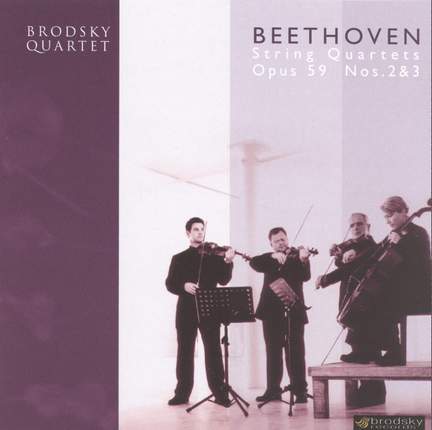
This isn't just another Rasumovsky recording: the Brodskys manage to sound thoroughly individual without ever seeming eccentric or onesided.
They pay close attention to detail – balance, articulation...
Special offer. Beethoven: String Quartets Op. 59, Nos. 2 & 3
Brodsky Quartet
Purchase product
This isn't just another Rasumovsky recording: the Brodskys manage to sound thoroughly individual without ever seeming eccentric or onesided.
They pay close attention to detail – balance, articulation...
About
Contents and tracklist
Work length39:21
- Brodsky Quartet (stringquartet), Andrew Haveron (violin), Ian Belton (violin), Paul Cassidy (viola), Jacqueline Thomas (cello)
- Recorded: 2005-10-14
- Recording Venue: Potton Hall, Dunwich, Suffolk
1. Allegro
Track length15:08
2. Molto adagio
Track length12:06
3. Allegretto
Track length7:16
4. Finale (Presto)
Track length4:51
Work length30:48
- Brodsky Quartet (stringquartet), Andrew Haveron (violin), Ian Belton (violin), Paul Cassidy (viola), Jacqueline Thomas (cello)
- Recorded: 2005-11-11
- Recording Venue: Potton Hall, Dunwich, Suffolk
1. Andante con moto - Allegro vivace
Track length10:33
2. Andante con moto quasi allegretto
Track length8:40
3. Menuetto grazioso
Track length5:24
4. Allegro molto
Track length6:11
Awards and reviews
 2010
2010
This isn't just another Rasumovsky recording: the Brodskys manage to sound thoroughly individual without ever seeming eccentric or onesided.
They pay close attention to detail – balance, articulation and accentuation are all carefully controlled – but as part of a performance full of conviction. One might argue that the interpretation is in places excessively literal: in the second quartet's first movement, for instance, where Beethoven writes staccato dots only at the start of a passage, it seems likely he intended the same articulation to persist. But the Brodsky performance, becoming smoother after the first bar, is convincing enough to prompt one to question such an assumption.
For the majority of movements the Brodskys stay close to Beethoven's metronome indications: the extraordinarily swift Presto finale of No 2 is revelatory and, in No 3, the flowing Andante con moto quasi allegretto, and the following Minuet, spacious and truly grazioso, would surely have pleased the composer. No 2's Moltoadagio moves serenely onwards at Beethoven's suggested 60 beats per minute: it's a lovely performance, but there's no doubt that groups adopting a slower speed – the Takács or the Busch, for example – achieve greater intensity.
The Brodskys don't always observe the metronome marks, however. For No 3's finale the tempo is slower than in many versions; but what's lost in brilliance is gained in dramatic power. And in No 2's opening Allegro, moderate and unhurried, we may miss something of the music's impulsive, disturbed character but can focus on a wealth of expressive detail. So it's well worth hearing this, however many Rasumovskys you have on your shelves.
 July 2006
This isn't just another Rasumovsky recording: the Brodskys manage to sound thoroughly individual without ever seeming eccentric or one-sided. They pay close attention to detail - balance, articulation and accentuation are all carefully controlled - but as part of a performance full of conviction.