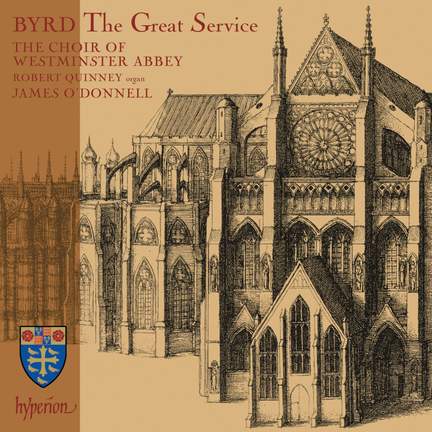
William Byrd - The Great Service
with additional anthems and organ voluntaries
Robert Quinney (organ)
The Choir of Westminster Abbey, James O'Donnell
This particular work needs no introduction; indeed, some fine recordings already exist of this set, which has become a particular favourite of modern choirs. The atmosphere one associates with...
William Byrd - The Great Service
with additional anthems and organ voluntaries
Robert Quinney (organ)
The Choir of Westminster Abbey, James O'Donnell
Purchase product
This particular work needs no introduction; indeed, some fine recordings already exist of this set, which has become a particular favourite of modern choirs. The atmosphere one associates with...
About
It is not known when or for whom William Byrd wrote his monumental Great Service, but we can be sure that he would approve of this new recording from Westminster Abbey. The second half of the sixteenth century was a heady time for the post-Reformation Church of England. Out of the ashes of the Catholic tradition a newand decidedly Anglicanmusical enthusiasm arose, and with it three distinct styles for settings of the Canticles, so central to Cranmers vision for the liturgy: short services presented their texts efficiently and simply, while verse services complicated proceedings with the addition of soloists and more intricate textures; great, or full, services extended this development to create musical structures of astonishing diversity, and at the very peak of the genre comes William Byrds masterpiece, widely regarded as the finest unaccompanied setting of the service ever made. The Great Service is here presented in its correct liturgical order (with the inclusion of the frequently omitted Kyrie) and is complemented by six of Byrds finest anthems and two organ voluntaries from My Lady Nevells Booke, a collection of Byrds keyboard music put together in 1591.
Contents and tracklist
Awards and reviews
 2010
2010
This particular work needs no introduction; indeed, some fine recordings already exist of this set, which has become a particular favourite of modern choirs. The atmosphere one associates with this combination of 'artist and repertoire' is present in abundance: warmth and intimacy combined with a certain reserve. At times the latter quality is perhaps too marked, or could have been leavened with a hint of extroversion: the opening track, perhaps, OLord, make thy servant Elizabeth. On the other hand the final selection, Sing joyfully (which, like the opening track, is sung a cappella) does indeed sound joyful.
In The Great Service itself, the character of the interpretations is entirely appropriate, and the choir may be heard at its best there. Its warmth of tone is due to the admixture throughout TheGreat Service of a chamber organ, sensitively handled by Robert Quinney. In the anthem Christ rising again the two treble soloists (accompanied by the organ) alternate with the full choir, a strategy that seems unconvincing because the music doesn't always lend itself to so strongly sectional an approach. Otherwise it's very polished and confident performance. Quinney gives equally fluent renditions of the Voluntary and 'Fancie for My Ladye Nevell', completing a disc that fulfils its brief with distinction.
 March 2006
The atmosphere one associates with this combination of 'artist and repertoire' is present in abundance: warmth and intimacy combined with a certain reserve. In The Great Service itself, the character of the interpretations is entirely appropriate, and the choir may be heard at its best there. The warmth of tone... is due to the admixture throughout The Great Service of a chamber organ, sensitively handled by Robert Quinney. ...a disc that fulfils its brief with distinction.