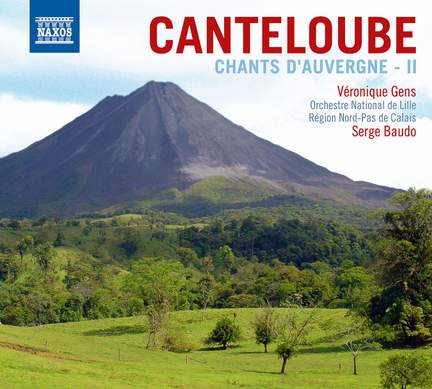
Canteloube - Chants d'Auvergne, Volume 2
Véronique Gens (soprano)
Orchestre National de Lille, Serge Baudo
Awards:
-
Gramophone Magazine, December 2007, Editor's Choice

In her second volume, including 'Chut, Chut' and 'Lo Fiolairé', Véronique Gens does more than confirm her credentials. The voice is bright, forward, notably clear in diction and lightly responsive...
Canteloube - Chants d'Auvergne, Volume 2
Véronique Gens (soprano)
Orchestre National de Lille, Serge Baudo
Purchase product
Awards:
-
Gramophone Magazine, December 2007, Editor's Choice
In her second volume, including 'Chut, Chut' and 'Lo Fiolairé', Véronique Gens does more than confirm her credentials. The voice is bright, forward, notably clear in diction and lightly responsive...
About
Contents and tracklist
Awards and reviews
-
Gramophone MagazineDecember 2007Editor's Choice
 November 2007
In her second volume, including 'Chut, Chut' and 'Lo Fiolairé', Véronique Gens does more than confirm her credentials. The voice is bright, forward, notably clear in diction and lightly responsive to nuance, backed by prominent woodwind and lean strings.
 2010
2010
For her second CD devoted to Joseph Canteloube's vocal music, Véronique Gens has looked beyond the celebrated, much-recorded Chantsd'Auvergne, and back to Tryptique, composed in 1913. Canteloube dedicated this to Maggie Teyte but the First World War interrupted its progress, and it was not until 1923 that Jane Campredon gave the premiere, with the Colonne orchestra conducted by Gabriel Pierné.
A setting of three poems by Roger Frêne, its lush, not to say extravagant orchestration anticipates Canteloube's later folksong settings. The influence of both Ravel and Debussy is obvious, maybe also Stravinsky (it was, after all, the year of The Rite of Spring). The first section, 'Offrande à l'été' is an ardent love song, with some pretty giddy scoring for harps. The central 'Lunaire' has a more mysterious, yearning feel, with a lovely little dissonance at the word 'cendre', as the poet imagines the leaves turning to ash. The finale, 'Hymne dans l'aurore' is an ecstatic prayer to Pan, celebrating every wonder of nature. The final cry, 'Mon âme s'ouvre ainsi qu'une aube étincellante! O Pan!' is marked in the score crescendo en grandissant, and Gens, Serge Baudo and the Lille orchestra rise to the moment with splendid force. It is really surprising that this work has not become better known; any soprano wanting to look beyond the obvious repertory should welcome it.
The rest of the disc is taken up with those remaining Auvergne songs not included on the earlier issue, conducted by Jean-Claude Casadesus.
Once again, Gens proves that an authentic knowledge of the dialect is a great advantage.
The much later group from Chants de France makes a pleasant end to the recital, but it is Tryptique that has to be heard.
 December 2007
For her second CD devoted to Joseph Canteloube's vocal music, Véronique Gens has looked beyond the celebrated, much-recorded Chants d'Auvergne, and back to Tryptique, composed in 1913. A setting of three poems by Roger Frêne, its lush, not to say extravagant orchestration anticipates Canteloube's later folksong settings. The first section, "Offrande à l'été" is an ardent love song... The central "Lunaire" has a more mysterious, yearning feel... The finale, "Hymne dans l'aurore" is an ecstatic prayer to Pan, celebrating every wonder of... The final cry, "Mon âme s'ouvre ainsi qu'une aube étincellante! O Pan!" is marked in the score crescendo en grandissant, and Gens, Serge Baudo and the Lille Orchestra rise to the moment with splendid force.