Weill & Vasks: Violin Concertos
Anthony Marwood (violin & conductor)
Academy of St Martin in the Fields
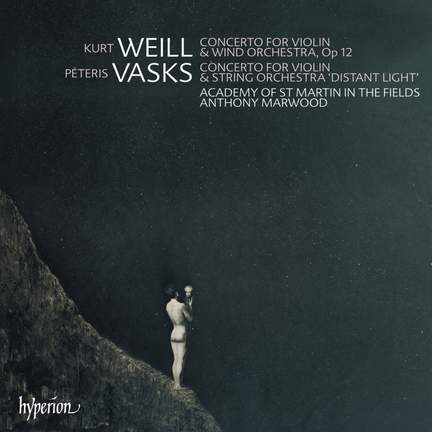
Anthony Marwood has championed the Vasks over a number of years and delivers a wonderfully moving and intense performance of the solo part. The strings of the Academy of St Martins in the Fields...
Weill & Vasks: Violin Concertos
Anthony Marwood (violin & conductor)
Academy of St Martin in the Fields
Purchase product
Anthony Marwood has championed the Vasks over a number of years and delivers a wonderfully moving and intense performance of the solo part. The strings of the Academy of St Martins in the Fields...
About
Kurt Weill (19001950) began his career in the early 1920s after a musical childhood and several years of study in Berlin with the composer-pianist Ferruccio Busoni. By 1926 he was an established young German-Jewish composer but he had already decided to devote himself to the musical theatre (he married the actress Lotte Lenya in 1926) and his works with Bertolt Brecht soon made him famous all over Europe. He fled the new Nazi leadership in March 1933 and lived in America for his remaining years. Weill composed his violin concerto in 1924; its orchestration and harmonies suggest the Second Viennese School and sit somewhere between Schoenberg and Stravinsky. Weill injects humorous and morose themes often mixing the two together as if they were indistinguishable. He uses the soloist-versus-orchestra format, the violin often competing against angular rhythms in the orchestra with an agitated lyrical line; there is also noticable jazz influence. The violin concerto by Latvian-born Peteris Vasks (b1946) could not be further removed from Weills astringent work. As with many composers who emerged from eastern Europe in the 1980ssuch as Arvo Part and Henryk GoreckiVasks music has a very strong spiritual theme, in particular the tension between contrasting worldsgood and evil. His concerto for violin is fragile, beautiful and otherworldly, with just a small section of chaos depicting the fight of evil which is soon stamped out. Anthony Marwoods silvery tone and immaculate intonation is again on display in this fascinating disc.
Contents and tracklist
Awards and reviews
 October 2005
Anthony Marwood has championed the Vasks over a number of years and delivers a wonderfully moving and intense performance of the solo part. The strings of the Academy of St Martins in the Fields are responsive partners maintaining a tight grip over the musical argument but without sacrificing any element of poetry. Their colleagues in the wind, brass and percussions departments prove equally adept in the spiky passage work of the Weill, and the lack of a separate conductor doesn't inhibit Marwood from extracting the maximum degree of virtuosity and sensitivity from Weill's knotty writing. ...a very special disc indeed.
 2010
2010
This new account of Vasks's Distant Light swells the number of recordings it has garnered to five, an amazing statistic for a work premiered as recently as August 1997. Then again, perhaps we shouldn't be too surprised: the Latvian's music speaks without artifice and offers an enticing blend of unspoilt beauty, compassionate heartache and superior compositional craft. Of all the competing versions, Gidon Kremer's pioneering Teldec reading has a charisma, intensity and concentration that are wholly arresting. More's the pity it has been deleted, so head-of-the-pack status must now pass to this excellently engineered newcomer. Anthony Marwood keeps a tight grip on the structural tiller and plays with exquisite polish and intimacy of feeling; he also secures an exceptionally alert and involving contribution from his Academy forces.
Winds, percussion and double basses assemble for the coupling, Kurt Weill's ambitious early Violin Concerto of 1923-24, which receives as persuasive and vital a performance as any. Marwood and company quarry every ounce of bony lyricism and spooky burlesque from what can initially seem a rather dry, unyielding creation.
Again, the sound is vividly realistic (if lacking just a whisker in bite and focus), and the disc as a whole certainly bodes well for Marwood's tenure as artistic director of the Irish CO.