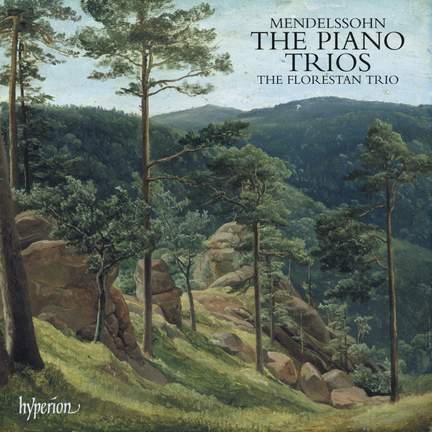
Mendelssohn - The Piano Trios
The Florestan Trio
Awards:
-
Gramophone Magazine, February 2006, Editor's Choice

What immediately impresses about these performances by the Florestan Trio is the lightness and clarity of the playing, with Susan Tomes characteristically sparing in her use of pedal. …this...
Mendelssohn - The Piano Trios
The Florestan Trio
Purchase product
Awards:
-
Gramophone Magazine, February 2006, Editor's Choice
What immediately impresses about these performances by the Florestan Trio is the lightness and clarity of the playing, with Susan Tomes characteristically sparing in her use of pedal. …this...
About
The Florestan Trio is firmly established as one of Britainsindeed the worldsmost distinguished and remarkably talented ensembles, their Hyperion recordings of Schubert, Schumann and Brahms receiving universal praise. Here they turn their attention to Mendelssohns two late piano trios and the performances are fresh and exhilarating! Mendelssohn was without doubt the most precociously gifted composer the world has ever known: not even Mozart produced mature masterpieces while still in his teens. He was also double prodigy on the violin and piano (Clara Schumann described him as the dearest pianist of all), an exceptional athlete, a talented poet (Goethe was a childhood friend and confidant), multi-linguist, watercolorist and philosopher. He excelled at virtually anything which could hold his attention for long enough, although it was music above all which activated his creative imagination. The well-known Op 49 in D minor and Op 66 in C minor represent the peak of Mendelssohns achievement in his relatively small output of chamber music; both trios are similar in structure and mood, beginning with a sombre and intense first movement, followed by a lyrical and melodic slow movement; the third movement is a fleeting and magical scherzo and ending with an energetic finale.
Contents and tracklist
Spotlight on this release
-
Felix Mendelssohn
20th Dec 2014
David picks out some recordings of the German Romantic composer Felix Mendelssohn.

Awards and reviews
-
Gramophone MagazineFebruary 2006Editor's Choice
 October 2005
What immediately impresses about these performances by the Florestan Trio is the lightness and clarity of the playing, with Susan Tomes characteristically sparing in her use of pedal. …this well-recorded new disc offers exceptionally fine accounts of these two great works.
 2010
2010
With its unforgettable opening cello theme, the D minor First has always been the more favoured of the two. But in a performance as subtle and impassioned as the Florestan's, the C minor Second seems at least as fine. The powerful, almost Brahmsian first movement alone should give the lie to the cliché that Mendelssohn's genius declined irredeemably after the brilliance of youth. While always keeping the potentially dense textures lucid (Susan Tomes's refined, singing tone and articulation a constant pleasure), the Florestan play this with a mingled fire and lyrical tenderness that it's hard to imagine bettered.
The flowing barcarolle slow movement has a crucial quality of innocence, and the flickering nocturnal Scherzo is as delicate and pointed as you could wish, at a tempo close to Mendelssohn's optimistically fast marking, while the Chamber Mendelssohn 736 finale drives impulsively towards its triumphant chorale apotheosis, grandly inevitable rather than bombastic.
From the yearning opening, the great cello melody surging across the barlines, the Florestan are equally vivid in the D minor Trio. Scrupulously observant, as ever, of Mendelssohn's detailed dynamic markings, they make you more than usually aware of how much of the music is held down to piano and pianissimo; and the moment at the start of the recapitulation, where Richard Lester's warm cello is counterpoised with violinist Anthony Marwood's fragile, floated descant, is as magical as you will hear.
Again the Florestan favour an easily flowing tempo for the song-without-words slow movement, phrasing in long spans (uncommonly pure, luminous duetting from Marwood and Lester) and finding a touch of playfulness when the main theme returns. Just as fine are the irresistible airborne Scherzo and the finale, where the Florestan, taking note of the qualifying unpoco tranquillo, make the opening march unusually pensive before sweeping forward with an authentically Mendelssohnian mix of restless agitation, grace and lyrical fervour. Pleasure in these superb performances is enhanced by a beautifully natural recording and Robert Philip's detailed, illuminating notes.
 February 2006
With its unforgettable opening cello theme, the D minor First has always been the more favoured of the two. But in a performance as subtle and impassioned as the Florestan's, the C minor Second seems at least as fine. The powerful, almost Brahmsian first movement alone should give the lie to the cliché that Mendelssohn's genius declined irredeemably after the brilliance of youth. ...the Florestan play this with a mingled fire and lyrical tenderness that I have never heard bettered. From the yearning opening, the great cello melody surging across the barlines, the Florestan are equally vivid in the D minor Trio. Pleasure in these superb performances is enhanced by a beautifully natural recording and Robert Philip's detailed, illuminating notes.
 2011 edition
Dazzling playing from this splendid ensemble puts the Florestan Trio at the very top of the list for these attractive and much-recorded works. The freshness of response and the virtuosity of the pianist, the inimitable Susan Tomes, make this coupling pretty irresistable.
 December 2014
This pairing of Mendelssohn's two Piano Trios from the Florestan Trio combines a deeply-felt lyricism with a lightness of touch (respecting among other things the sheer quietness of the dynamics) -enabling the graceful side of these works to come through. Pianist Susan Tomes is particularly excellent.