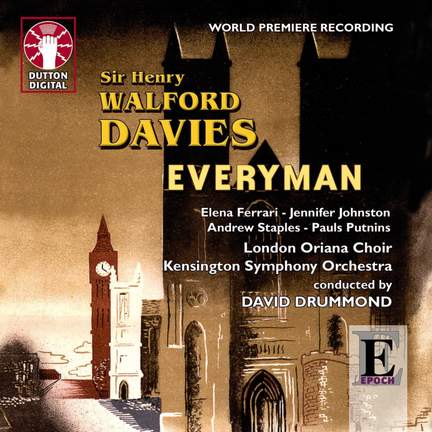
Davies, Walford: Everyman
Elena Ferrari (soprano), Jennifer Johnston (contralto), Andrew Staples (tenor) & Pauls Putnins (bass)
London Oriana Choir & Kensington Symphony Orchestra, David Drummond
Awards:
-
Gramophone Magazine, February 2005, Editor's Choice

Henry Walford Davies's splendid oratorio was written and first heard in 1904, in the shadow of Elgar's Gerontius. Yet it was an immediate success and widely performed. But by the end of the...
Davies, Walford: Everyman
Elena Ferrari (soprano), Jennifer Johnston (contralto), Andrew Staples (tenor) & Pauls Putnins (bass)
London Oriana Choir & Kensington Symphony Orchestra, David Drummond
Purchase product
Awards:
-
Gramophone Magazine, February 2005, Editor's Choice
Henry Walford Davies's splendid oratorio was written and first heard in 1904, in the shadow of Elgar's Gerontius. Yet it was an immediate success and widely performed. But by the end of the...
About
Contents and tracklist
- Kensington Symphony Orchestra
- Kensington Symphony Orchestra, London Oriana Choir, Andrew Staples
- Kensington Symphony Orchestra, Andrew Staples, London Oriana Choir, Paul Putnins
Davies, Walford:
Part I - No. 4: Everyman's Lament 'Alas! / The Day Passeth, it is Almost Ago'
Work length6:03
- Kensington Symphony Orchestra, Paul Putnins, London Oriana Choir
- Kensington Symphony Orchestra, Paul Putnins, London Oriana Choir
Everyman's Appeal 'Ah Wither for Succour Shall I Flee' / to Kindred 'Here Be We Now'
Track length1:12
- Kensington Symphony Orchestra, Paul Putnins, London Oriana Choir
The Apppeal 'Where art thou My Goods and Riches?' / to Riches 'I Lie Here in Corners'
Track length2:06
- Kensington Symphony Orchestra, Elena Ferrari, Paul Putnins, Jennifer Johnston, London Oriana Choir
Davies, Walford:
Part II - No. 4: Song of Knowledge 'O Glorious Fountain that All Unclearness doth Clarify'
Work length3:31
- Kensington Symphony Orchestra, Jennifer Johnston, London Oriana Choir
- Kensington Symphony Orchestra, Paul Putnins, London Oriana Choir, Elena Ferrari
Davies, Walford:
Part II - No. 6: Everyman's Comfort 'Be No More Sad, but Evermore Rejoice'
Work length3:58
- Kensington Symphony Orchestra, Paul Putnins, Jennifer Johnston, Elena Ferrari, London Oriana Choir
- Kensington Symphony Orchestra, Paul Putnins, Elena Ferrari, London Oriana Choir
- Kensington Symphony Orchestra, London Oriana Choir
- Kensington Symphony Orchestra, London Oriana Choir
Awards and reviews
-
Gramophone MagazineFebruary 2005Editor's Choice
 2010
2010
Henry Walford Davies's splendid oratorio was written and first heard in 1904, in the shadow of Elgar's Gerontius. Yet it was an immediate success and widely performed. But by the end of the First World War it had fallen into oblivion, apart from an isolated revival in 1929. Like Gerontius, it's based on a vision of a human soul crossing into the next world, where Everyman has to justify his life to God.
It, too, offers dialogues between Everyman and the subsidiary characters, here representing Good Deeds (a particularly lovely duo) and Knowledge (jointly, the equivalent of Elgar's Angel). There's no 'Go forth' at the end of Part 1: here the choral sequences are more lyrical. Instead, Everyman learns that the attributes he's taken for granted in life (friends, possessions, physical attributes) will be left behind when he dies; riches, too, are sneeringly dismissed. The choral Epilogue brings a thrillingly optimistic conclusion. The solo parts must be very grateful to sing, and the soloists here rise to the occasion. The frequently inspired choral writing is at times Elgarian, though there's no hint of plagiarism, and the music is communicative and appealing.
David Drummond's direction has a powerful yet lyrical thrust, with the feeling of a live performance.
The recording is first class, too.