Simon Bainbridge: Ad ora incerta
Susan Bickley (mezzo) and Kim Walker (bassoon)
BBC Symphony Orchestra, Nash Ensemble, Martyn Brabbins
The BBC Symphony Orchestra plays beuatifully, fully cognisant of the weight of the message being conveyed... Required listening if ever there was.
Simon Bainbridge: Ad ora incerta
Susan Bickley (mezzo) and Kim Walker (bassoon)
BBC Symphony Orchestra, Nash Ensemble, Martyn Brabbins
Purchase product
The BBC Symphony Orchestra plays beuatifully, fully cognisant of the weight of the message being conveyed... Required listening if ever there was.
About
Bainbridge's Grawemeyer Award-winning Ad ora incerta ('At an uncertain hour'), is a deeply-felt symphonic setting of four poems by Auschwitz survivor Primo Levi. It is coupled with Four Primo Levi Settings.
Contents and tracklist
Awards and reviews

The BBC Symphony Orchestra plays beuatifully, fully cognisant of the weight of the message being conveyed... Required listening if ever there was.
 2010
2010
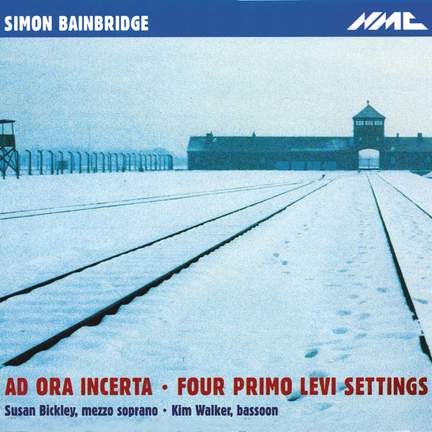
At the beginning of the fourth Primo Levi setting in Ad ora incerta (a depiction of the ghastly chemical factory attached to Auschwitz that Levi miraculously survived) there's a slow orchestral crescendo, like the panning of a camera to reveal the full horror of the scene. What follows isn't a shout of protest but sober lyricism, and when that crescendo returns it introduces an eloquently poignant melody. Simon Bainbridge is an uncommonly fine musical dramatist. He lets the words speak, and distils his music so as to clarify them. In Ad ora incerta the vocalist has a companion, a solo bassoon.
Because that fourth poem repeatedly speaks of a dead companion, of course, but also in the way the bassoon shadows or reflects the voice, there's also a subtle and moving suggestion that after Auschwitz Levi lacked and longed for a companion, a fellow survivor who would understand his memories in ways that none of us can. It's scarcely believable that these beautiful but painful poems could be set to music; certainly not with the delicate and imaginative sympathy that Bainbridge shows here.
The four chamber settings are still sparer but no less gravely beautiful. In the seven brief lines of the first of them Levi distils the impossibility of communicating his experiences yet the imperative need to try. Bainbridge's setting conveys that, but adds the most restrained and loving pity. It's a remarkable and a deeply moving achievement. Both performances are fine, that of the chamber settings beyond praise in its quiet intimacy.