Special offer. Haydn: String Quartets
The Angeles String Quartet
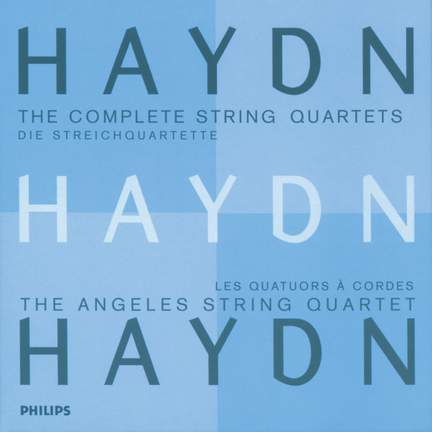
The most relevant comparisons for this collection are the Aeolian Quartet on Decca and the Kodály Quartet on Naxos. The all-digital Naxos series features performances that are, in the main,...
Special offer. Haydn: String Quartets
The Angeles String Quartet
Purchase product
The most relevant comparisons for this collection are the Aeolian Quartet on Decca and the Kodály Quartet on Naxos. The all-digital Naxos series features performances that are, in the main,...
About
Contents and tracklist
- Kathleen Lenski (violin), Steven Miller (violin), Brian Dembow (viola), Steve Erdody (cello)
- The Angeles String Quartet
- Recorded: 1995-04
- Recording Venue: St.Stephen's Episcopal Church, Belvedere, CA
- Kathleen Lenski (violin), Steven Miller (violin), Brian Dembow (viola), Steve Erdody (cello)
- The Angeles String Quartet
- Recorded: 1995-04
- Recording Venue: St.Stephen's Episcopal Church, Belvedere, CA
- Kathleen Lenski (violin), Steven Miller (violin), Brian Dembow (viola), Steve Erdody (cello)
- The Angeles String Quartet
- Recorded: 1995-09
- Recording Venue: St.Stephen's Episcopal Church, Belvedere, CA
- Kathleen Lenski (violin), Steven Miller (violin), Brian Dembow (viola), Steve Erdody (cello)
- The Angeles String Quartet
- Recorded: 1995-02
- Recording Venue: St.Stephen's Episcopal Church, Belvedere, CA
- Kathleen Lenski (violin), Steven Miller (violin), Brian Dembow (viola), Steve Erdody (cello)
- The Angeles String Quartet
- Recorded: 1999-04
- Recording Venue: St.Stephen's Episcopal Church, Belvedere, CA
- Kathleen Lenski (violin), Steven Miller (violin), Brian Dembow (viola), Steve Erdody (cello)
- The Angeles String Quartet
- Recorded: 1999-04
- Recording Venue: St.Stephen's Episcopal Church, Belvedere, CA
- Kathleen Lenski (violin), Steven Miller (violin), Brian Dembow (viola), Steve Erdody (cello)
- The Angeles String Quartet
- Recorded: 1995-06
- Recording Venue: St.Stephen's Episcopal Church, Belvedere, CA
- Kathleen Lenski (violin), Steven Miller (violin), Brian Dembow (viola), Steve Erdody (cello)
- The Angeles String Quartet
- Recorded: 1999-06
- Recording Venue: St.Stephen's Episcopal Church, Belvedere, CA
- Kathleen Lenski (violin), Steven Miller (violin), Brian Dembow (viola), Steve Erdody (cello)
- The Angeles String Quartet
- Recorded: 1999-04
- Recording Venue: St.Stephen's Episcopal Church, Belvedere, CA
- Kathleen Lenski (violin), Steven Miller (violin), Brian Dembow (viola), Steve Erdody (cello)
- The Angeles String Quartet
- Recorded: 1995-04
- Recording Venue: St.Stephen's Episcopal Church, Belvedere, CA
- Kathleen Lenski (violin), Steven Miller (violin), Brian Dembow (viola), Steve Erdody (cello)
- The Angeles String Quartet
- Recorded: 1995-12
- Recording Venue: St.Stephen's Episcopal Church, Belvedere, CA
- Kathleen Lenski (violin), Steven Miller (violin), Brian Dembow (viola), Steve Erdody (cello)
- The Angeles String Quartet
- Recorded: 1997-02
- Recording Venue: St.Stephen's Episcopal Church, Belvedere, CA
- Kathleen Lenski (violin), Steven Miller (violin), Brian Dembow (viola), Steve Erdody (cello)
- The Angeles String Quartet
- Recorded: 1996-04
- Recording Venue: St.Stephen's Episcopal Church, Belvedere, CA
- Kathleen Lenski (violin), Steven Miller (violin), Brian Dembow (viola), Steve Erdody (cello)
- The Angeles String Quartet
- Recorded: 1996-06
- Recording Venue: St.Stephen's Episcopal Church, Belvedere, CA
- Kathleen Lenski (violin), Steven Miller (violin), Brian Dembow (viola), Steve Erdody (cello)
- The Angeles String Quartet
- Recorded: 1996-10
- Recording Venue: St.Stephen's Episcopal Church, Belvedere, CA
Awards and reviews
 2010
2010
The most relevant comparisons for this collection are the Aeolian Quartet on Decca and the Kodály Quartet on Naxos. The all-digital Naxos series features performances that are, in the main, musically reliable and technically proficient.
But turn back to the 1973-6 Aeolian series, and every work becomes an event, every quirk of harmony, rhythm or timing is etched with maximum relish.
Comparative disc layouts begin to differ from CD 3, and the Angeles omit The Seven LastWords, a work which, beautiful as it is, wasn't originally written for string quartet. Recordingwise, Philips favours a warm, open sound, balanced much as you would hear it from the centre stalls in a smallish-size concert hall. Decca's analogue recordings are closer, dryer, more sensitive to extraneous noise and commonly balanced in favour of Emanuel Hurwitz's first violin.
It's a clear and intimate sound frame and the leader bias actually suits the divertimento-style early quartets, but Philips's more refined engineering makes for less strenuous listening in concert-length sessions. A handful of edits are the only blots on Philips's otherwise immaculate aural landscape.
The svelte texture of the Angeles' pooled sound, their consistent evenness in full chords and the musical like-mindedness of individual players, whether in excited prestos or in shared rubato is admirable. As to contrasts in playing styles, think of the relatively smooth-toned Juilliard or Emerson Quartets (Angeles) as compared with the internally differentiated Amadeus Quartet (Aeolian). The Angeles are generally lighter, faster and subtler in their use of tone colouring whereas the Aeolians' roster of virtues includes strong (even emphatic) characterisation, consistently flexible phrasing and a more pungent approach to rhythm.
Surfing the set for good sampling points brings us, initially, to the early quartets, where both groups sport some superb first-violin solo work, tastefully inflected with Lenski, more candidly expressive with Hurwitz. A particularly telling comparison is provided by the quietly contrapuntal Minuet of Op 17 No 1, where the Angeles' seamless legato contrasts against the Aeolians' near staccato. The exquisite Adagio of Op 20 No 6 is another good place to compare, the Angeles with their perfectly timed pauses, warm cello line and overall restraint set against the more romantic, even rhapsodic, Aeolian. Listening to the first bars of Op 33 No 1 is like eavesdropping on a small gathering mid-conversation, where the cello line gradually gains in urgency. The Angeles' sotto voce handling of the scherzo to Op 33 No 3 is wonderful: it's rather more pensive than the Aeolians and marks much more of a contrast with the chirping trio.
Op 50 No 4's Andante anticipates the dramatic interjections that trouble various late Schubert slow movements. Both groups are effective here, though when the cello marks an expected change of key two minutes or so into the movement, it's the Aeolian's Derek Simpson who makes the biggest impact: you can almost see the rosin erupt from his strings. In Op 50 No 5 late Beethoven springs more readily to mind, but there the Angeles' extra speed and restraint is more effective. Note how beautifully they negotiate the quiet alternation between upper and lower voices towards the end of Op 50 No 6's Poco adagio and the sudden blossoming that follows.
Then again, Op 54 No 1's mobile Allegretto second movement harbours the potential to switch from tenseness to lyrical effusiveness, which the Angeles exploit to the full, as they do for the rhapsodising Adagio of Op 54 No 2. Late Beethoven is evoked once more, this time the Cavatina from Op 130.
Beam up around three minutes into the Adagio of the Lark Quartet (Op 64 No 5) and you'll note how skilfully the Angeles cue a ritardando, while the bracing finale to Op 74 No 3 has just the right bounce to offset all the breathless excitement. The Sunrise Quartet (Op 76 No 4) opens like a spring flower (never more so than in the Angeles' ecstatically controlled performance) and Op 77 No 1's cheeky Allegro moderato bounds in with perfectly modulated high spirits.
Turning to other competition, the Lindsays, Amadeus, Vienna Konzerthaus, Quatuor Mosaïques, Pro Arte and Takács, all have added substantiallyto the Haydn quartet discography, and all have their value. However, in this particular context it really is a head-to-head contest between two 'complete' sets similarly presented.
Richard Wigmore contributes detailed annotation, quite different from Lindsay Kemp's overview for Decca, but just as useful and equally well written. The Angeles appeal perhaps primarily for their restrained expressiveness and consistent attention to detail. Philips's superior recording is another bonus. The Aeolians generate more immediate heat but, ultimately, the Angeles' intelligence and cooler blending pay the higher musical dividends.