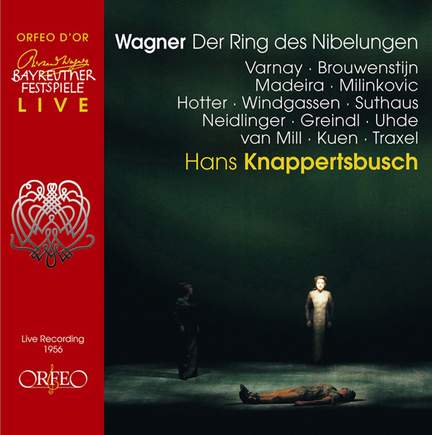
Wagner: Der Ring des Nibelungen
Das Rheingold
Hans Hotter (Wotan), Ludwig Suthaus (Loge), Gustav Neidlinger (Alberich), Georgine von Milinkovic (Fricka), Josef Greindl (Fasolt), Arnold van Mill (Fafner), Gré Brouwenstijn (Freia), Alfons Herwig (Donner), Josef Traxel (Froh), Paul Kuën (Mime), Jean Madeira...
During the pioneering post-war era at Bayreuth the conducting of the Ring was shared among the Ks – Karajan, Krauss, Knappertsbusch, Keilberth and Kempe. These conductors collectively had a...
Wagner: Der Ring des Nibelungen
Das Rheingold
Hans Hotter (Wotan), Ludwig Suthaus (Loge), Gustav Neidlinger (Alberich), Georgine von Milinkovic (Fricka), Josef Greindl (Fasolt), Arnold van Mill (Fafner), Gré Brouwenstijn (Freia), Alfons Herwig (Donner), Josef Traxel (Froh), Paul Kuën (Mime), Jean Madeira...
Purchase product
During the pioneering post-war era at Bayreuth the conducting of the Ring was shared among the Ks – Karajan, Krauss, Knappertsbusch, Keilberth and Kempe. These conductors collectively had a...
About
Contents and tracklist
- Georgine von Milinkovič (mezzo-soprano), Paul Kuen (tenor), Jean Madeira (mezzo-soprano), Gré Brouwenstijn (soprano), Mária von Ilosvay (contralto), Paula Lenchner (soprano), Lore Wissmann (soprano), Josef Greindl (bass), Gustav Neidlinger (baritone), Hans Hotter (bass-baritone), Josef Traxel (tenor), Alfons Herwig (baritone), Arnold van Mill (bass), Ludwig Suthaus (tenor)
- Bayreuther Festspielorchester
- Hans Knappertsbusch
- Recorded: 13 August 1956
- Recording Venue: Live recording, Bayreuth, Germany
Scene 2: Endlich Loge! Eiltest du so (Wotan, Loge, Fricka, Froh, Donner, Fafner, Fasolt)
Track length4:05
Scene 2: Nicht gonn' ich das Gold dem Alben (Fasolt, Fafner, Loge, Wotan, Fricka, Donner)
Track length6:46
Scene 4: Gepflanzt sind die Pfahle nach Pfandes Mass (Fafner, Wotan, Loge, Froh, Fricka, Donner, Fasolt, Freia)
Track length3:12
Scene 4: Freia, die Schone, schau' ich nicht mehr (Fasolt, Fafner, Loge, Wotan, Freia, Fricka, Froh)
Track length3:16
- Hans Hotter (bass-baritone), Astrid Varnay (soprano), Hilde Scheppan (soprano), Georgine von Milinkovič (mezzo-soprano), Luise Charlotte Kamps (vocals), Wolfgang Windgassen (tenor), Jean Madeira (mezzo-soprano), Gré Brouwenstijn (soprano), Gerda Lammers (soprano), Josef Greindl (bass), Elisabeth Schärtel (alto), Mária von Ilosvay (contralto)
- Bayreuther Festspielorchester
- Hans Knappertsbusch
- Recorded: 13 August 1956
Act III Scene 1: Nicht sehre dich Sorge um mich (Sieglinde, Brunnhilde, Walkuren, Wotan)
Track length7:14
Act III Scene 2: Hier bin ich, Vater: gebiete die Strafe! (Brunnhilde, Wotan, Walkuren)
Track length9:38
- Gustav Neidlinger (baritone), Ilse Hollweg (soprano), Jean Madeira (mezzo-soprano), Astrid Varnay (soprano), Arnold van Mill (bass), Paul Kuen (tenor), Wolfgang Windgassen (tenor), Hans Hotter (bass-baritone)
- Bayreuther Festspielorchester
- Hans Knappertsbusch
- Recorded: 15 August 1956
- Recording Venue: Live recording, Festspielhaus, Bayreuth, Germany
Act I Scene 1: Vieles lehrtest du, Mime, und manches lernt' ich von dir; (Siegfried, Mime)
Track length9:00
Act I Scene 3: Hoho! Hoho! Hohei! Schmiede, mein Hammer, ein hartes Schwert (Siegfried, Mime)
Track length5:05
Act II Scene 3: Hei! Siegfried erschlug nun den schlimmen Zwerg! (Waldvogels, Siegfried)
Track length4:28
- Gustav Neidlinger (baritone), Lore Wissmann (soprano), Mária von Ilosvay (contralto), Hermann Uhde (baritone), Gré Brouwenstijn (soprano), Paula Lenchner (soprano), Astrid Varnay (soprano), Josef Greindl (bass), Jean Madeira (mezzo-soprano), Wolfgang Windgassen (tenor)
- Bayreuther Festspielorchester, Chor der Bayreuther Festspiele
- Hans Knappertsbusch
- Recorded: 75 August 1956
Act II Scene 4: Einen Ring sah ich an deiner Hand (Brunnhilde, Siegfried, Gunther, Hagen, Gutrune, Mannen, Frauen)
Track length3:39
Act II Scene 4: Heil'ge Gotter, himmlische Lenker! (Brunnhilde, Gunther, Frauen, Mannen, Siegfried, Gutrune, Hagen)
Track length6:43
Act III Scene 1: Frau Sonne sendet lichte Strahlen (Woglinde, Wellgunde, Flosshilde, Siegfried)
Track length4:46
Act III Scene 1: Siegfried! … Was schiltst du so in den Grund? (Flosshilde, Wellgunde, Woglinde, Siegfried)
Track length3:25
Act III Scene 1: Was leid ich doch das karge Lob? (Siegfried, Flosshilde, Woglinde, Wellgunde)
Track length3:39
Act III Scene 1: Siegfried! Siegfried! Wir weisen dich wahr (Flosshilde, Woglinde, Wellgunde, Siegfried)
Track length6:39
Act III Scene 2: Hoiho! … Finden wir endlich, wohin du flogest? (Hagen, Siegfried, Mannen, Gunther)
Track length6:57
Act III Scene 2: Mime hiess ein murrischer Zwerg (Siegfried, Hagen, Mannen, Gunther)
Track length10:04
Awards and reviews
 2010
2010
During the pioneering post-war era at Bayreuth the conducting of the Ring was shared among the Ks – Karajan, Krauss, Knappertsbusch, Keilberth and Kempe. These conductors collectively had a knowledge and experience of the cycle not equalled before or since, with the sole exception of their contemporary Furtwängler, who returned after the war only to conduct Beethoven's Ninth.
Although they were brought up in the same, exemplary tradition, the Ks had very different ways of treating the Ring, as you can now discover given the availability of so many cycles on CD. Krauss in his superb 1953 cycle went for a lean, dramatic, often electrifying and elating approach. He shared the cycles with Keilberth in 1953 after Karajan refused to return to Bayrreuth, and was scheduled to return in 1954. His sudden death left Keilberth solely in charge in 1954 and '55. We now have the elusive Keilberth cycle of 1955 from Testament, a version recorded by Decca but never issued. This now becomes the first stereo recording.
In 1956 Knappertsbusch, who had shared the 1951 cycles with Karajan returned to give what is generally agreed to be his most successful reading, taken as a whole. Unlike Krauss, Karajan and to a lesser extent Keilberth, the older conductor took a more measured view of the scores overall, one based on his preference for the long paragraph, well defined, almost pawky rhythms, and prominent ritardandi at points not always indicated in the score. At moments he seems to lose focus and let things run their own way where ensemble is concerned but, as a whole, especially in Rheingold and Götterdämmerung, his epic view of the score is almost unsurpassed. Even in the two middle operas there are moments of alternating quiet reflection and earthy energy that are very special.
He has at his command an ensemble of dedicated singers who had built their characterisations to a peak of achievement by 1956. Practically all are German-speaking and all have the art of acting with their voices in an immediate and communicative way, not to forget that they each had voices of a Wagnerian power too seldom found today.
Throughout Rheingold astonishment and delight are responses once more to the frightening power and presence of Gustav Neidlinger's trenchantly sung Alberich and by the detail, feeling and vocal authority of Hans Hotter's unsurpassed Wotan. Beside them an erstwhile Siegfried, Ludwig Suthaus, offers a Loge who gives every word, even syllable a distinctive colour and meaning, while Jean Madeira's Erda emits other-worldly authority.
And any Rheingold that boasts Josef Traxel, then a leading lyric tenor in Germany, as Froh has a bonus.
Four singers heard in later operas are introduced here. Paul Kuen, another familiar figure, is Mime and provides character without exaggeration.
Georgine von Milinkovic introduces us to an imperiously nagging Fricka and comes into her own in the next work. Josef Greindl is a formidable if unsubtle Fasolt, later a granite Hunding and a fearsome Hagen: no wonder, given so much work to do, he sometimes tires a little. Gré Brouwenstijn, a properly worried Freia, then gives us a Sieglinde who develops, in glorious tones, from an introvert to an extrovert when love strikes her. Beside her is Wolfgang Windgassen, standing in at the last moment for an ailing Vinay, and singing a Siegmund who is at once bel canto in line yet intensely eloquent.
Incredibly, the next evening he is a tirelessly effective Siegfried.
Hotter is magnificent in Wotan's Act 2 monologue, here made to seem at the very heart of the whole cycle, and as ever deeply moving in his Act 3 Farewell, forgiving signs of vocal weariness at the start of the act. By then we have met and admired Astrid Varnay's very womanly yet Opera Wagner 1278 heroic Brünnhilde. She occasionally overdoes the histrionics but by and large she has the character in her voice and bones in a way few other dramatic sopranos have managed.
In Siegfried Hotter manages ideally the humour of his Act 1 colloquy with Mime, his face-off with Neidlinger's Alberich in Act 2, and his desperation when meeting Madeira's implacable Erda at the start of Act 3. The awakening of Brünnhilde is not one of the conductor's best moments but the lovers give their all in the closing duet.
All the momentous climaxes of the cycle's finale find Kna at his most potent and involved, just as in 1951, and Varnay seconds him with her projection of all Brünnhilde's joy and sorrow. She also – incredibly – took on the Third Norn, at very short notice, Mödl having been taken suddenly ill. Madeira is heard again to advantage as both First Norn and Waltraute – would any singer do both today? Act 2 is simply tremendous. In this work Brouwenstijn returns as a vocally comely Gutrune, and Hermann Uhde, as in all the 1950s cycles, is an unsurpassed Gunther. With the Immolation one rightly feels that the earth has moved and that one has been through a lifeenhancing experience, which is as it should be.
Music & Arts issued this cycle in 1998 but this is the first issue with the Bayreuth imprimatur, though the sound quality is only marginally superior here. Orchestral textures are sometimes muted but that has much to do with the opera house's layout. No texts or translations but a good booklet, which quotes one contemporary critic as saying this was undoubtedly the Festival's greatest moment to date. Allegiance to the 1953 Krauss set is not altered but there is much here that remains unsurpassed.
 February 2006
…Knappertsbusch… took a more measured view of the scores overall, one based on his preference for the long paragraph, well defined, almost pawky rhythms, and prominent ritardandi… At moments he seems to lose focus and let things run their own way where ensemble is concerned but, as a whole, especially in Rheingold and Götterdämmerung, his epic view of the score is almost unsurpassed. Even in the two middle operas there are moments of alternating quiet reflection and earthy energy that are very special. He has at his command an ensemble of dedicated singers who had built their characterisations to a peak of achievement by 1956.