Strauss: Arabella & Vier letzte Lieder
Lisa della Casa (Arabella), Anneliese Rothenberger (Zdenka), Dietrich Fischer-Dieskau (Mandryka), Kurt Ruesche (Matteo), Otto Edelmann (Waldner), Ira Malaniuk (Adelaide), Eta Köhre (Fiakermilli), Helmut Melchert (Elemer), Georg Stern (Dominik), Lisa della Casa (soprano)
Wiener Philharmoniker,...
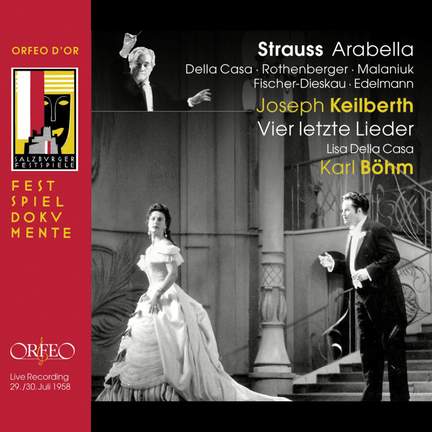
A performance recorded by DG in Munich in 1963 had the same Arabella, Mandryka and conductor.
That production originated in 1958 at the Salzburg Festival and it is a broadcast of its auspicious...
Strauss: Arabella & Vier letzte Lieder
Lisa della Casa (Arabella), Anneliese Rothenberger (Zdenka), Dietrich Fischer-Dieskau (Mandryka), Kurt Ruesche (Matteo), Otto Edelmann (Waldner), Ira Malaniuk (Adelaide), Eta Köhre (Fiakermilli), Helmut Melchert (Elemer), Georg Stern (Dominik), Lisa della Casa (soprano)
Wiener Philharmoniker,...
Purchase product
A performance recorded by DG in Munich in 1963 had the same Arabella, Mandryka and conductor.
That production originated in 1958 at the Salzburg Festival and it is a broadcast of its auspicious...
About
Contents and tracklist
- Lisa della Casa, Anneliese Rothenberger, Kerstin Meyer, Kurt Ruesche, Helmut Melchert, Otto Edelmann, Ira Malaniuk, Dietrich Fischer-Dieskau, Wilhelm Lenninger
- Wiener Philharmoniker
- Joseph Keilberth
- Otto Edelmann, Ira Malaniuk, Lisa della Casa, Dietrich Fischer-Dieskau, Helmut Melchert, Georg Stern, Karl Weber, Eta Köhrer, Anneliese Rothenberger, Kurt Ruesche, Wilhelm Lenninger
- Wiener Philharmoniker
- Joseph Keilberth
- Otto Edelmann, Ira Malaniuk, Lisa della Casa, Dietrich Fischer-Dieskau, Kurt Ruesche, Wilhelm Lenninger
- Wiener Philharmoniker
- Joseph Keilberth
Awards and reviews
 2010
2010
A performance recorded by DG in Munich in 1963 had the same Arabella, Mandryka and conductor.
That production originated in 1958 at the Salzburg Festival and it is a broadcast of its auspicious first night that appears here for the first time on disc. That was also the year Decca recorded the work with Della Casa under Solti, so there are interesting comparisons.
What cannot be in dispute is that the part of Arabella might have been written for Della Casa.
Excellent as some of her successors may have been, she remains supreme. In 1958 she was at her vocal and interpretative peak: everything she does ravishes the senses. To an even greater extent than in the studio, she inhabits the character from start to finish. Haughty and off-hand with previous lov ers, she aurally melts when coming across 'Der Richtige', the right man for her, in the person of Mandryka. The softness and glow of her singing at the end of Act 1 and the start of Act 2 is balm to the ear, as are her ravishing pianissimi throughout.
Then, when Mandryka unjustly accuses her of infidelity, the tremble suggests all the hurt he is causing her. That's banished when all is cleared up in the ineffably beautiful finale; a memorable climax to a great portrayal.
Fischer-Dieskau on stage was the rough-hewn, impulsive Mandryka to the life. His performance has enormous presence and vitality but he is rather inclined to go into his hectoring mode, with line-breaking over-emphases (George London on Decca may be preferred).
The Adelaide and Waldner are common to Orfeo and Decca, both admirable in depicting the Viennese bourgeoisie.
As Zdenka, Hilde Gueden (Decca) is slightly preferable to Rothenberger on Orfeo and DG because of her greater ease on high. Anton Dermota (Decca) is a more fluent Matteo than Karl Ruesche, a tenor unknown to me.
Keilberth lays a lighter, more lyrical hand on the score than Solti but unfortunately makes the common and disfiguring cuts in Act 3. The Decca set enjoys early stereo against Orfeo's mono. But Della Casa, caught on the wing and in freshest voice, is not be missed.
A clinching factor may be the inclusion of the Four Last Songs, recorded at Salzburg the night after the Arabella. Here she, Böhm and the VPO renew their famous alliance in this work from their classic 1953 recording on Decca. Unlike other interpreters they still start with 'Beim Schlafengehen'. In other respects there are improvements. Speeds overall are a little slower, allowing for subtler shades of colouring, more intensity of feeling, and the voice itself is more rounded. It seems a version that fulfils every one of the work's exigent demands, and surpasses even those by Schwarzkopf, Popp and Janowitz for sheer tonal beauty and sheen, placing it at the top of the pile as the most favoured reading, although it has to be said that the orchestral palette is restricted by modern standards.