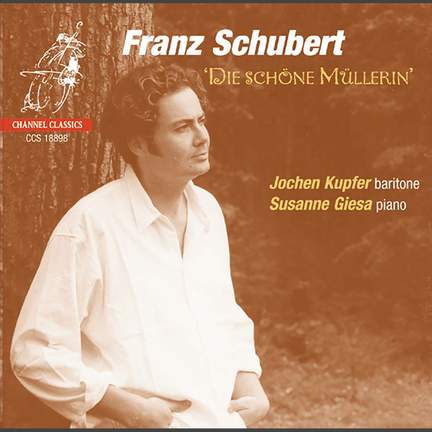
Special offer. Schubert: Die schöne Müllerin, D795
Jochen Kupfer (baritone) and Susanne Giesa (piano)
Awards:
-
Gramophone Magazine, March 2003, Editor's Choice

This reading of Schubert's cycle is confirmation, as if that were needed, of Jochen Kupfer's beautiful singing, and even more of his gifts as a Lieder interpreter. Kupfer's voice and style is...
Special offer. Schubert: Die schöne Müllerin, D795
Jochen Kupfer (baritone) and Susanne Giesa (piano)
Purchase product
Awards:
-
Gramophone Magazine, March 2003, Editor's Choice
This reading of Schubert's cycle is confirmation, as if that were needed, of Jochen Kupfer's beautiful singing, and even more of his gifts as a Lieder interpreter. Kupfer's voice and style is...
About
Contents and tracklist
- Jochen Kupfer, Susanne Giesa
Awards and reviews
-
Gramophone MagazineMarch 2003Editor's Choice
 2010
2010
This reading of Schubert's cycle is confirmation, as if that were needed, of Jochen Kupfer's beautiful singing, and even more of his gifts as a Lieder interpreter. Kupfer's voice and style is highly reminiscent of Wolfgang Holzmair's, but his technique is just that shade firmer and his voice more youthful than the older baritone's with Imogen Cooper, recalling rather Holzmair's first (1983) recording on Preiser. Both artists have a tenor-like quality to their voices, coming near to some ideal for the work. Kupfer begins with the basic verities of immaculate line and imaginative phrasing, to which he adds a complete identification with the youthful lover's aspirations and eventual disappointment and tragedy.
This lad sets out with a spring in his heels and a smile in his voice, quite avoiding any sense of despondency from the outset. All is going to be well in his wooing. That's conveyed in the first few songs with fresh immediacy as though the poetic emotions and their setting were newminted.
The arrival of the unwanted and aggressive hunter provokes an almost breathless jealousy and, in that arresting song, 'Die liebe Farbe', an appropriately mesmeric, plaintive approach.
From there on the downward curve of emotional feeling, so arrestingly depicted in the words and music, finds in Kupfer and his alert partner an answering mood of despair, the raw and anguished passion in those final three songs fully achieved. All the while you feel the disillusionment and pathos in the texture and verbal acuity of the interpretation.
With a finely balanced recording to add to one's pleasure, this is a performance among baritones to place very near the top of the pile, if not at its apex, and it challenges even the prevailing tenor recommendations, the versions by Ian Bostridge and Werner Güra.